

SlideServe
Menu
Préférences
© SlideServe · v2026

Addition

sidney avatar
19 diapositives · 431 Views · Aug 08, 2014

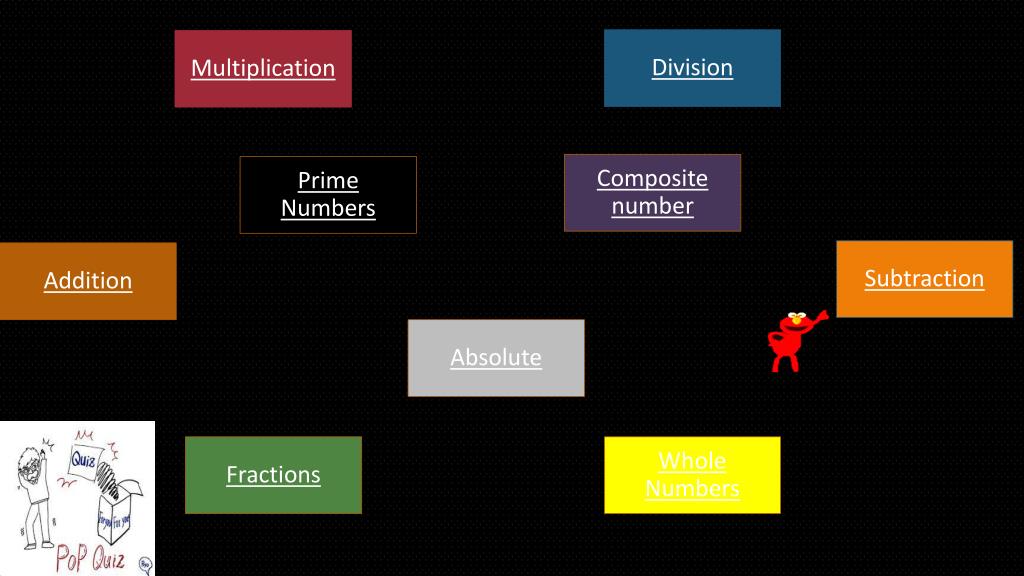
Addition. Multiplication. Division. Subtraction. Fractions. Whole Numbers. Composite number. Prime Numbers. Absolute. The basic idea of multiplication is repeated addition. Ex: 5 × 3 = 5 + 5 + 5 = 15. Multiplication.
Addition - slide 1
01 / 19Addition
1 / 17

Télécharger la présentation

Addition
Une image / un lien ci-dessous est fourni (tel quel) pour télécharger la présentation

Politique de téléchargement : le contenu du site vous est fourni TEL QUEL pour votre information et votre usage personnel ; il ne peut être vendu, concédé sous licence ni partagé sur d’autres sites sans l’accord de son auteur.Le contenu vous est fourni TEL QUEL, pour votre information et votre usage personnel uniquement. Téléchargez la présentation en cliquant sur ce lien. Lors du téléchargement, si vous ne parvenez pas à télécharger une présentation, l’éditeur a peut-être supprimé le fichier de son serveur.Pendant le téléchargement, si vous ne parvenez pas à obtenir une présentation, le fichier a peut-être été supprimé par l’éditeur.

F I N

Plus de contenu associé

Transcription de la présentation
  1. Addition Multiplication Division Subtraction Fractions Whole Numbers Composite number Prime Numbers Absolute

  2. The basic idea of multiplication is repeated addition.Ex: 5 × 3 = 5 + 5 + 5 = 15 Multiplication

  3. Division is splitting into equal parts or groups. It is the result of "fair sharing".Example: there are 12 strawberries, and 3 friends want to share them, how do they divide the strawberries?Answer: They should get 4 each. 12/3 or 12÷3= 4 Division

  4. Addition is finding the total, or sum, by combining two or more numbers. Example: 5 + 11 = 16 is an addition Addition

  5. Taking one number away from another.If you have 10 apples and you subtract 2, you will be left with 8.The symbol of subtraction is -Example: 10 - 2 = 8 Subtraction

  6. The numbers {0, 1, 2, 3, ...} etc.There is no fractional, decimal part, or no negatives.Example: 2, 50 and 1000 are all whole numbers. Whole Numbers

  7. A Prime Number can be divided evenly only by 1, or itself. And it must be a whole number greater than 1.Example: 7 can only be divided evenly by 1 or 7, so it is a prime number. Prime Numbers

  8. The bottom number (the denominator) says how many parts the whole is divided into The top number (the numerator) says how many you have. Fractions

  9. How far a number is from zero.Example “4" is 4 away from zero, but "-4" is also 4 away from zero.So, the absolute value of 4 is 4, and the absolute value of -4 is also 4.The symbol "|" is placed either side to mean "Absolute Value", so we can write: |-4| = 4 . Absolute Numbers

  10. A whole number that can be divided evenly by numbers other than 1 or itself.Example: 81 can be divided evenly by (as well as 1 and 9), so 81 is a composite number. Composite Number

  11. Practice Problems What is 2 x 9? 18 7 11

  12. Practice Problems What is 8 ÷ 2 6 10 4

  13. Practice Problems What is 52 + 48? 50 4 100

  14. Practice Problems What is 100 – 50? 100 25 50

  15. Congratulation's Your correct Wow you are awesome give yourself a pat on the back you are getting it now. Don’t stop here keep going your doing great keep up the great work!!!!!

  16. Congratulation’s You are Correct You only have two more to go keep up the good work!!!!

  17. Congratulation’s Your Correct You are doing great keep up the great work only one more to go keep it up!!! Almost to the finish line

  18. Congratulation’s Your Correct You have fully completed the Quiz great Job!!!! Thanks for participating Great Work!!!!

  19. Sorry Wrong answer try again!! Its ok don’t give up your close keep trying you can do it!!!