Economic Factors Influencing Hydrothermal Mineral Deposits and Ore Distribution
This section analyzes the economic factors influencing the concentration of valuable minerals and ores found in hydrothermal deposits. Hydrothermal minerals, often deposited from hot fluids associated with igneous intrusions, include essential metals like Pb, Fe, Hg, Cu, Zn, Ag, and Au. Factors determining the economic concentration include the abundance of these elements in deposits compared to their crustal abundance. Additionally, it discusses the formation of common metal sulfide ores, the role of plate tectonics, and the significance of seabed ore deposits, including manganese nodules.

Economic Factors Influencing Hydrothermal Mineral Deposits and Ore Distribution
E N D
Presentation Transcript
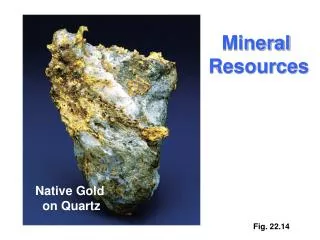
Mineral Resources Native Gold on Quartz Fig. 22.14
Economic Concentration Factors* of Some Commercially Important Elements * Concentration factor = abundance in deposit divided by crustal abundance Table 22.1
Amount of Primary and Recycled Metals Used in the U.S. from 1960-2000 Fig. 22.15
Hydrothermal Mineral Deposits • hydrothermal deposits: minerals deposited from hot waters, usually associated with igneous intrusions • These fluids carry 'low temperature ions'; when the fluids cool off (near surface) the solubility goes down and minerals with Pb, Fe, Hg, Cu, Zn, Ag, Au, etc., are precipitated
Descending ground water dissolved metal oxides and sulfides, to be heated by magma, rise in hydrothermal fluids, and re-precipitated as hydrothermal ores Fig. 22.16
Some Metal Sulfide* Ores * Sulfides are the most common of the metallic ores Fig. 22.17
Some Copper Ores Fig. 22.18
Kennecott Open Pit Copper Mine, Utah Fig. 22.19
Chromite (chrome ore, dark layers) in a Layered Igneous Intrusive, South Africa Fig. 22.20
Precambrian Banded Ore Deposits, Australia Fig. 22.21
Large Quantities of Sulfide Ores Form at Mid-ocean Spreading Centers Fig. 22.22
Role of Plate Tectonic Setting in Controlling Distribution of Ore Deposits Fig. 22.23
Manganese Nodules* From the Deep Seafloor * May contain up to 20% Mg ~7.5 cm Fig. 22.24
Location of Some Major Non-fuel Seabed Ore Deposits Fig. 22.25