The Outbreak of World War I: Causes, Technology, and America's Entry
Chapter 10 delves into the complex roots of World War I, highlighting key factors such as imperialism, nationalism, and militarism. The assassination of Archduke Franz Ferdinand sparked a global conflict amidst intricate alliances. Technological advancements including tanks, machine guns, and poison gas radically changed warfare. As the United States navigated its path to war, President Woodrow Wilson faced challenges like maintaining neutrality and the Zimmermann Telegram. The chapter also examines the home front's contributions and the war's lasting legacy, including the Treaty of Versailles and its repercussions.

The Outbreak of World War I: Causes, Technology, and America's Entry
E N D
Presentation Transcript
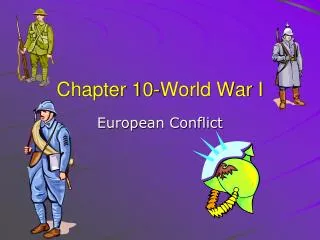
Chapter 10-World War I European Conflict
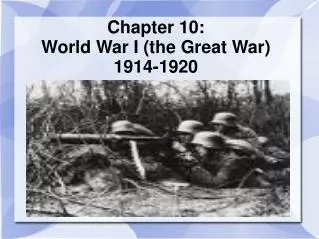
War Breaks Out in Europe/Section 1 • Causes of WWI • Imperialism • Nationalism • Militarism • Alliances • Stalemate • Trench warfare-trench foot
Trigger of WWI • There were 4 main long-term reasons for the war, but there was one trigger. • Assassination of Archduke Franz Ferdinand and Archduchess Sophia
Technology • Tanks • Fighter planes-German-Red Baron (Baron von Richthofen) and Eddie Rickenbacker (American) • Machine guns • Poison gas • Submarines-U-boats,torpedoes
America’s Path to War • President Woodrow Wilson • Neutrality • Lusitania-ship • Zimmerman Telegram-from Germany to Mexico
Russian Revolution • Czar Nicholas II and family overthrown • Bolshevik Revolution • Communism-Vladimir Lenin • Reds • Effect- Russia withdraws from war-leaves Allies at a disadvantage
America Joins the Fight/Section 2 • Raising an army and navy • John J. Pershing-General of American Expeditionary Force (AEF) • Selective Service Act-draft • Women in the military for first time • African-American troops segregated
Ships/Troops/Pushing Germans Back • Convoy system-cruisers and destroyers protect merchant ships • American troops enter the war-Cantigny, Chateau-Thierry, Belleau Wood • Second Battle of the Marne-turning point of the war • Alvin York • African-American combat units
Armistice • Germany surrenders • Nov 11, 1918-Armistice Day/Veterans Day • The 11th hour of the 11th day of the 11th month • More people died from disease than from bullets • Led to starvation and flu epidemic
Life on the Home Front/Section 3 • Study this section well! Many of the things that you will learn for WWI “on the home front” will be the same for WWII. (prior knowledge-text to text connections) • Mobilizing-getting ready • War bonds/liberty bonds, sold by government, Hollywood stars
Life on the Home Front continued • Children- rolled bandages • Collected tin cans • Saved apricot pits • Boy Scouts helped • Families- planted “victory gardens” knitted socks for soldiers • Wheatless days and meatless days
Life on the Home Front continued • Conserve gasoline • Women donating corsets • Propaganda-writers, artists, photographers, filmmakers • Prejudice- German shepherds called “police dogs” sauerkraut called “liberty cabbage” hamburger called “Salisbury steak” • Espionage Act, Sedition Act
The Great Migration/Flu Epidemic • Hundreds of thousands of African-Americans moved North to look for factory jobs and to escape the prejudice of the South. Great Migration • 8.5 million soldiers died in the war • 20 million people died from the flu
The Legacy of the War • Fourteen Points- Wilson’s ideas for peace • League of Nations • Treaty of Versailles- Germany must accept full blame, had to pay $33 BILLION in reparations, lost its colonies and army • New countries created from land that Germany lost • Wilson likes Treaty of Versailles-Senate votes NO
More problems after the war • Red Scare because of Bolshevik Revolution • Palmer Raids • Sacco and Vanzetti • Racial tensions-African-Americans had fought for democracy in Europe but had no rights at home in the U.S. • Race riots in the North • Harding runs for president promising Normalcy