Enhancing Butanol Production: Insights from the 2007 Virginia Genetically Engineered Machine Team
310 likes | 429 Vues
The 2007 Virginia Genetically Engineered Machine (iGEM) Team, comprised of interdisciplinary students, explored synthetic biology solutions to improve butanol biosynthesis. With no prior research in this area at UVA, the team raised $50,000 and created a metabolic pathway in E. coli to produce butanol from renewable sources. They focused on integrating cellulase systems and exploring proteorhodopsin for energy efficiency. Although challenges in butanol tolerance persist, their innovative approaches to genetic engineering and collaboration lay the groundwork for future advancements in biofuels.


Enhancing Butanol Production: Insights from the 2007 Virginia Genetically Engineered Machine Team
E N D
Presentation Transcript
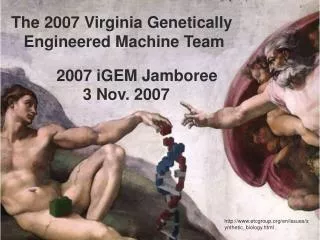
The 2007 Virginia Genetically Engineered Machine Team 2007 iGEM Jamboree 3 Nov. 2007 http://www.etcgroup.org/en/issues/synthetic_biology.html
The 2007 VGEM Team University-wide, interdisciplinary science and engineering collaboration among students and faculty Amy, George, Kevin, Ranjan, and Emre
Advisors Ron Bauerle Jason Papin Erik Fernandez Brianne Ray Kay Christopher
Birth of the Team • First UVA iGEM team • Founded, organized and run by us • 16 undergraduates applied • We raised $50,000 and secured lab space • No prior synthetic biology research at UVA • We taught ourselves basic synthetic biology
Project Brainstorming • Bacterial melanogenesis • Ethylene biosensing • Autonomous drug delivery • Cellular photosignalling • Directed angiogenesis http://www.calvin.edu/academic/chemistry/faculty/muyskensmark http://news.bbc.co.uk/cbbcnews/hi/animals/newsid_3233000/3233962.stm Nature. 2000 Jan 20;403(6767):335-8.
Butanol Biosynthesis: Background & Motivation • 90 years ago- Butanol first produced in a lab setting via fermentation • 1950s- Butanol produced petrochemically due to lowered cost • Today- Need for alternate energy source BP DuPont Biofuels. www2.dupont.com/Biofuels/en_US/index.
Butanol Biosynthesis:Background & Motivation • Advantages of Butanol over Ethanol • Less corrosive • Lower latent heat of vaporization • Higher energy density • Less hygroscopic • Fits within current infrastructure • Liquid at atmospheric temperature and pressure • Easily blends with other fuels • Can be used in existing internal combustion engines http://www.bioenergywiki.net/index.php/Biobutanol
Butanol Biosynthesis:Background & Motivation • Butanol is renewable! • However, production is not currently economically feasible • More research is necessary • High cost of substrate • Toxicity to the fermenting organisms
Butanol Biosynthesis: Objectives • Design, model, and modularly construct a metabolic pathway in E. coli that includes the following: • A butanol-producing metabolic pathway • From Clostridium acetobutylicum • A cellulase system (cheap carbon source) • Select enzymes from Saccharophagus degradans • Proteorhodopsin, a light metabolism system (free energy) • Discovered via marine metagenomic analysis • Increase E.coli butanol tolerance via engineering and/or evolution
Proteorhodopsin • Requires retinal • Added to media, not biosynthesized Martinez, A., A. Bradley, J. Waldbauer, R. Summons and E. F. DeLong. 2007. Proteorhodopsin photosystem gene expression enables photophosphorylation in a heterologous host. PNAS.
Results: Butanol Tolerance • Typical Tolerance: 0.8-1.2% (vol/vol) • Unable to get consistent results • At higher butanol concentrations (>1.2%), occasionally cells would survive • These cells were unable to keep butanol tolerance and would be killed if transferred to a new broth
Mathematical Model • Model → experiment → model → etc. • Metabolic pathway → stoichiometric matrix • Flux balance analysis • Fermentation products • Pathway bottlenecks • Knockout simulations
Conclusions • Cellulases and butanol-producing enzymes may be toxic to E. coli • Simple directed evolution of E. coli may not be an effective way of increasing butanol tolerance • Proteorhodopsin is a potential energy-provider for chemical synthesis in E. coli under anaerobic conditions
Ongoing Work • Determine what went wrong with our BioBrick construction and whether or not they are lethal to E. coli • If possible, assemble BioBricks into composite systems • Incorporate better or more membrane-associated solvent efflux pumps to increase tolerance • Incorporate the retinal pathway • Incorporate more diverse cellulases • Complete the central butanol biosynthesis pathway • Design and optimize complete bioprocess
Improvements • Expansion of the team to include more departments at UVA (materials science, electrical engineering, chemistry) • Future funding by corporate sponsorship • Potential intro synthetic biology course to educate new researchers and spread the word. • Better communication with iGEM personnel and other teams (more community-oriented) to solve common problems
Acknowledgements • Our advisors: Erik Fernandez, Jason Papin, Ron Bauerle, Brianne Ray, and Kay Christopher • Our academic sponsors: Office of the VP for Research, School of Engineering, U.Va. Engineering Foundation, School of Medicine, and the departments of Biomedical Engineering, Chemical Engineering, Biology, and Microbiology • Our corporate sponsor: DNA2.0
References • [1] Andrykovitch, G., & Marx, I. (1988). Isolation of a new polysaccharide-digesting bacterium from a salt marsh. Applied and Environmental Microbiology, 54(4), 1061-1062. • [2] Beja, O., Aravind, L., Koonin, E., Suzuki, M., Hadd, A., Nguyen, L., et al. (2000). Bacterial rhodopsin: Evidence for a new type of phototrophy in the sea. Science, 289(5486), 1902-1906. • [3] Borden, J., & Papoutsakis, E. (2007). Dynamics of genomic-library enrichment and identification of solvent tolerance genes for clostridium acetobutylicum. Applied and Environmental Microbiology, 73(9), 3061-3068. • [4] Martinez, A., Bradley, A. S., Waldbauer, J. R., Summons, R. E., & DeLong, E. F. (2007). Proteorhodopsin photosystem gene expression enables photophosphorylation in a heterologous host. Proceedings of the National Academy of Sciences, 104(13), 5590-5595. • [5] Nolling, J., Breton, G., Omelchenko, M., Makarova, K., Zeng, Q., Gibson, R., et al. (2001). Genome sequence and comparative analysis of the solvent-producing bacterium clostridium acetobutylicum. The Journal of Bacteriology, 183(16), 4823-4838. • [6] Taylor, L.,II, Henrissat, B., Coutinho, P., Ekborg, N., Hutcheson, S., & Weiner, R. (2006). Complete cellulase system in the marine bacterium saccharophagus degradans strain 2-40T. The Journal of Bacteriology, 188(11), 3849-3861.
Experiment 1:Testing Alcohol Dehydrogenase aad, aad2 aad, aad2 + alcohol dehydrogenase?
Experiment 2: Butanol biosynthesis from butyric acid atoA atoD
Experiment 3:Cellulose as an Alternate Energy Source cellobiohydrolase, cellobiase Native