Understanding the Steps of the Scientific Method: From Observation to Conclusion
The scientific method is a systematic approach used to investigate phenomena, develop new knowledge, or correct and integrate previous knowledge. It involves several key steps: Observation, where scientists notice a phenomenon; Hypothesis, a testable prediction; Experiment, a procedure to test the hypothesis; Data Collection, organizing results; Conclusion, determining the hypothesis's validity based on data; and Retesting to verify the findings. Key concepts include control and experimental variables to ensure valid results, highlighting the importance of systematic investigation in science.

Understanding the Steps of the Scientific Method: From Observation to Conclusion
E N D
Presentation Transcript
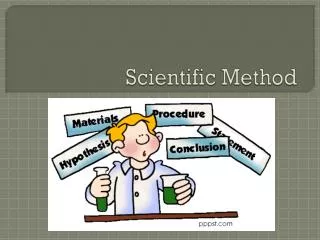
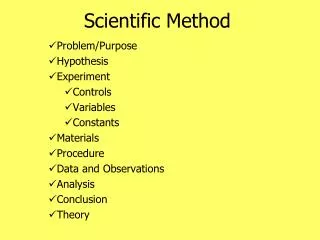
Steps in the Scientific Method • Observation • Hypothesis • Experiment • Data Collection • Conclusion • Retest
Observations • Gathered through your senses • A scientist notices something in their natural world
Observations • An exampleof an observation might be noticing that many salamanders near a pond have curved, not straight, tails
Hypothesis • A suggested solution to the problem. • Must be testable • Sometimes written as If…Then… statements • Predicts an outcome
Hypothesis • An example of a hypothesis might be that the salamanders have curved tails due to a pollutant in the moist soil where they live.
Experiment • A procedure to test the hypothesis.
Experiment Variable – factor in the experiment that is being tested
Experiment A good or “valid” experiment will only have ONE variable!
Scientific Experiments Follow Rules • An experimenter changes one factor andobserves or measureswhat happens.
The Control Variable • The experimenter makes a special effort to keep other factors constant so that they will not affect the outcome. • Those factors are called control variables.
What is the Purpose of a Control? • Controls are NOT being tested • Controls are used for COMPARISON
Other Variables • The factor that is changed is known as the independent variable. • The factor that is measured or observed is called the dependent variable.
Example of Controls & Variables • For example, suppose you want to figure out the fastest route to walk home from school. • You will try several different routes and time how long it takes you to get home by each one. • Since you are only interested in finding a route that is fastest for you, you will do the walking yourself.
What are the Variables in Your Experiment? • Varying the route is the independent variable • The time it takes is the dependent variable • Keeping the same walker throughout makes the walker a control variable.
One more thing… it is best to make several trials with each independent variable.
Remember: To be a Valid Experiment: • Two groups are required --- the control & experimental groups • There should be only onevariable
Data • Results of the experiment • May be quantitative (numbers) or qualitative (words)
Data • Must be organized • Can be organized into charts, tables, or graphs
Conclusion • The answer to the hypothesis based on the data obtained from the experiment
Retest In order to verify the results, experiments must be retested.
Recap: To Solve a Problem 1)Identify a Problem 2) State Observations about the problem 3) Form a Hypothesis about the problem (if…then…) 4) Design an Experiment to test the hypothesis 5) Collect Data 6) Form a Conclusion 7) Retest
Review… No need to write these slides down in notebook
In what part of the scientific method do you write an investigative question? • Identify the problem
What are the two parts of the analysis? • Create a graph and write a summary
A conclusion needs to support orrepudiate your _____________. • hypothesis
How do we record data in an experiment? • data tables (rows and columns)
The independent variable may change the ________ variable in an experiment. • dependent
When we are finished with our experiments we ____________ our findings. • communicate
What do we call informationcollected during the experiment? • Data
The procedure is a list of__________ that describes the experiment. • Steps
How many times should an experiment be repeated? • Many times to help average issues such as human error
Variables that are kept the same are called ___________ • controls