Download
1 / 8
190 likes | 509 Vues
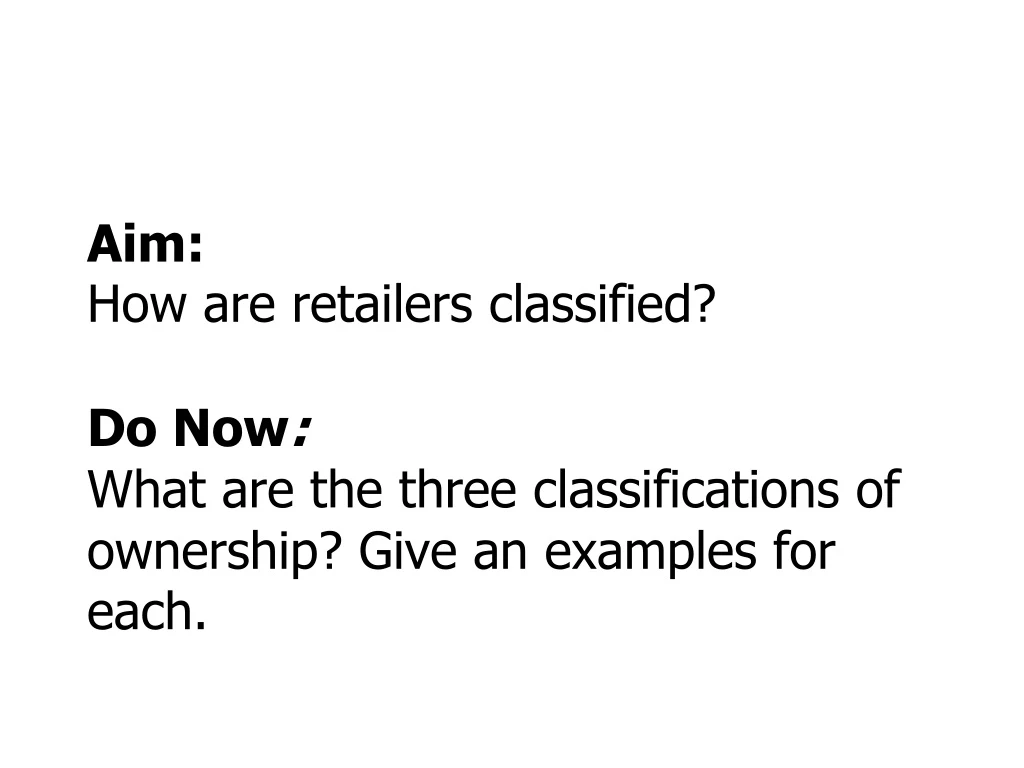
Retailers can be classified based on ownership and store types. The three classifications of ownership are: independent retailers (e.g., local boutiques), franchise retailers (e.g., Subway), and chain retailers (e.g., Walmart). Stores vary in type and product assortment. Specialty stores focus on narrow product lines with deep assortments, while department stores offer a wide variety of products within separate departments. Supermarkets specialize in food items, and convenience stores provide quick access to high-turnover goods. This classification helps consumers understand retail options.

E N D
Aim:How are retailers classified?Do Now: What are the three classifications of ownership? Give an examples for each.
Store Type Length and Breadth of Product Assortment Specialty Stores Narrow Product Line, Deep Assortment Department Stores Wide Variety of Product Lines i.e. Clothes, Home Furnishings & Household Items Supermarkets Wide Variety of Food, Laundry, & Household Products Convenience Stores Broad Product Line, Low Margin, High Volume Limited Line of High-Turnover Convenience Goods Discount Stores Off-Price Retailer Inexpensive, Overruns, Irregulars, and Leftover Goods Superstores Large Assortment of Routinely Purchased Food & Nonfood Products, Plus Services Catalog Showroom Broad Selection, Fast Turnover, Discount Prices Classification Of Retailer Types
Department Stores • Offer a variety of merchandise grouped into separate departments • Prestigious reputation of higher quality, fashion, and customer service • Heavy advertisers, large buying and sales volume that help lower expenses
Specialty Stores • Specializing in a given type of merchandise • Carry large selections of limited classifications of merchandise • Lower volume and higher prices than discounters • Customer service and give advice about the selection of goods within their specialties
Supermarkets- • a large departmentalized, self-service retailer that specializes in food and some nonfood items. • Being replaced by superstores (1-stop shopping) • Example: Whole Foods
Drug Stores- • a retail store that stocks pharmacy related products and services as its main draw. • Consumers are most often attracted a drugstore by its pharmacy, its convenience, or because it honors their prescription plan. • Example: Rite Aid
Convenience Stores • Miniature supermarket carrying only a limited line of high turnover convenience goods • Usually open 24 hours/7 days a week (7-11) • Fast service • Convenient location • Prices are higher than a supermarket