Download
1 / 10
100 likes | 219 Vues
American imperialism marked a significant shift in foreign policy during the late 19th and early 20th centuries. Driven by the desire for economic benefits, American leaders sought new markets and raw materials by dominating weaker nations. The establishment of colonies, often described as extractive economies, provided essential resources. Influenced by notions of cultural superiority and strategic military interests, the U.S. expanded its influence through naval force, the acquisition of territories, and diplomatic initiatives across the Caribbean and Asia, shaping its role on the world stage.

E N D
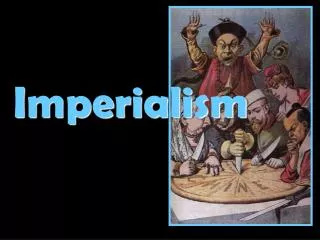
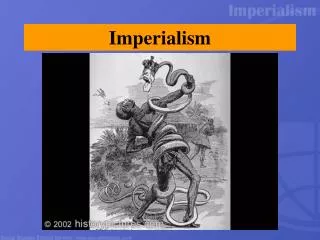
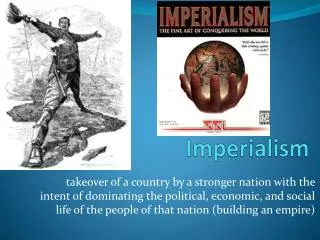
Imperialism • Stronger nation attempt to create empires by dominating weaker nations • Do this • Economically • Politically • Militarily
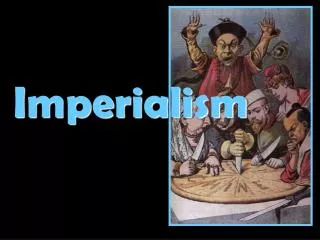
European Nations • Had already begun to Imperialize • Britain • France • German • Carved up Africa and established claims in Asia • “Sun never sets on the British Empire”
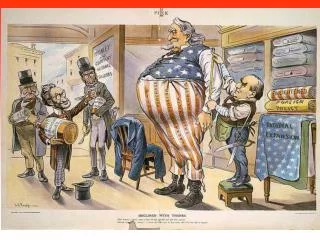
US Imperialists Seek Economic Benefits • Raw materials and natural resources • Tea, rubber, iron , petroleum • Colonies are called Extractive Economies • Foreign trade the solution to overproduction, unemployment, and economic depression • Competition among industrial nations for markets
US Imperialists Stress the Need for a Strong Navy • Construction of The Great White Fleet (a modern naval fleet) to protect • economic interests • Colonies over seas • Prosperity depends on strength of navy • Two ocean navy • Build canal at the isthmus of Panama • Control the Caribbean Sea • Ideas of US Admiral Alfred T. Mahan
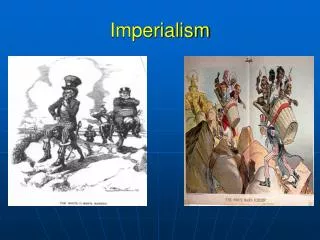
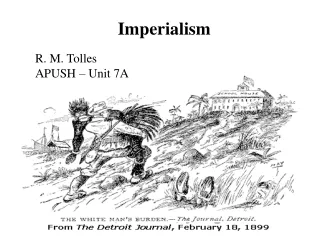
US Imperialists Believe in Cultural Superiority • Social Darwin • Certain nations were superior to others and therefore were destined to rule over inferior cultures • God had granted them the right and responsibility • Continuation of Manifest Destiny • White Man’s Burden • Missionary wanted to spread Christianity
Perry opens up Japan • Seward buys Alaska • US annexes Hawaii • US goes to war with Spain • US takes Guam, Puerto Rico, and Philippines • Involved in Cuba • Open Door Policy in China • Influence in Latin America grows • Aid rebellion in Panama • Dollar Diplomacy in the Dominican Republic • Moral Diplomacy in Mexico
Results • America has new role in the world • Imperialism is new foreign policy