Download
1 / 13
130 likes | 268 Vues
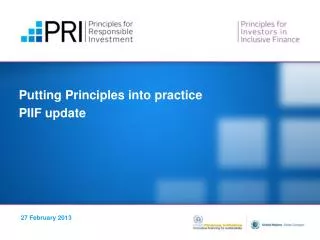
The February 2013 update on the Principles for Investors in Inclusive Finance (PIIF) highlights the commitment of signatories to enhance financial services for low-income individuals. It outlines key areas such as client protection, integrating ESG factors, and transparency in operations. Results from the pilot Reporting Framework reveal strong implementation evidence among direct investors, with significant room for improvement in social returns and governance. This update sets the stage for future advancements, including the launch of new reports and a transparency tool in October 2013.

E N D
27 February 2013 Putting Principles into practice PIIF update
PIIF update Putting the Principles into practice • Guidance and support to accompany the Principles • Signatories’ actions: sharing practice • Results of PIIF pilot Reporting Framework
Principles for Investors in Inclusive Finance Signatories commit to adhering to and promoting the following: • Expanding the range of financial services available to low-income people • Integrating client protection into all policies and practices • Treating investees fairly, with clear and balanced contracts, and dispute resolution procedures • Integrating ESG factors into policies and reporting • Promoting transparency in all operations • Pursuing balanced long-term returns that reflect the interests of clients, retail providers and end investors • Working together to develop common investor standards on inclusive finance
1. Guidance and support • Client protection initiative • For MIVs only* • Client protection initiative • For MIVs only* • Social commitment initiative • Social commitment initiative • Key:
3. Results of Reporting Framework pilot • 28 pilot participants – 15 direct investors and 13 indirect investors • Summary report presents information provided by direct investors only: • Mainly based in Europe and N America • Directly manage US$ 6.5bn in inclusive finance • Findings cannot be generalised to all signatories: • The data is self-reported and not audited • Small sample size • Self-selecting nature of participation in the pilot • Not all signatories reported against all indicators
Highlights Strong evidence of implementation, with room for improvement • The pilot found high commitment among direct investor participants to: • invest in retail providers that offer a range of services; • adopting client protection practices; • providing both debt and equity with a range of terms and conditions to investees; • participating in industry-wide initiatives to develop common standards. • Areas where there is room for improvement include: • incentivising social returns; • playing an active role in corporate governance; • investors’ transparency and their encouragement of investees’ transparency on pricing and other terms and conditions to the ultimate client.
PIIF 4: Including ESG issues in our investment policies and reporting Environmental performance • Nearly 90% of participants have a procedure to integrate environmental issues into their investment decision making. • This is a larger % than reported by MIVs in Symbiotics 2012 survey (66%).
PIIF 5: Actively promoting transparency • Over 90% of participants disclose their policies, criteria and related conditions of products and services to investees and other stakeholders on their websites. • Nearly 70% provide information aligned to the MIV Disclosure Guidelines, whilst half provide information aligned with the Impact Reporting and Investment Standards (IRIS). • 14 out of 15 (93%) of participants report that they ensure that investees adequately disclose the pricing and 13 out of 15 (87%) ensure disclosure of other terms and conditions of financial products offered.
PIIF 6: Striving for balanced, long-term social and financial returns
Next Steps • Launching October 2013 • Outputs include: • Individual responsible investment reports (public) • Individual assessment reports, carried out by PRI(private) – in development • Aggregated Report on Progress (public) • Transparency tool, intended to encourage dialogue between asset owners and investment / fund managers