
Galileo, Newton, and the Laws of Motion
E N D
Presentation Transcript
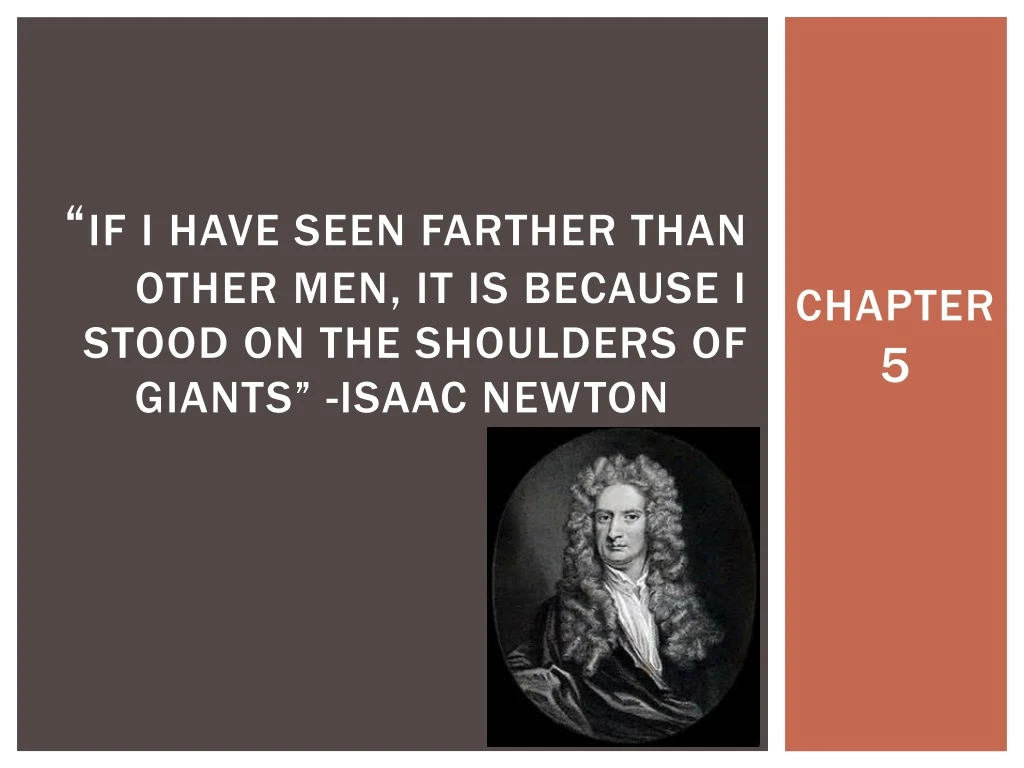
“If I have seen farther than other men, it is because I stood on the shoulders of giants” -Isaac newton CHAPTER 5
5-1 Galileo and newton • Kepler discovered the 3 laws of planetary motion, but he did not understand WHY the planets move along their orbit. • (Make sure you review and know all 3 laws for the chapter 4 and 5 test!!) • He thought that maybe it was a magnetic force or angels pushing the planets along.
5-1 Galileo and newton • Newton was born in England- the year Galileo died • He refined Kepler’s model of planetary motion, but did not perfect it • Newton discovered gravity (the concept of), but did not understand what gravity was.
5-1 Galileo and newton • Aristotle- 4 elements Earth, Water, Air and Fire • Believed objects fall downward because they are moving toward their proper place. • Called these motions natural motions vs violent motions, push and object and make it move other than its proper place.
5-1 Galileo and newton • Galileo- before building his first telescope he studied motion and conducted his own experiments. • Dropping objects- he found the velocities were so great and the time it took the object to drop was short, it was difficult to measure accurately. • rolling balls down a gently sloping incline- found bodies do not fall at constant rates, but are accelerated • Objects move faster with each passing second (9.8m/s)= Acceleration of gravity
5-1 Galileo and newton • Apollo 15 astronaut David Scott
5-1 Galileo and newton • Galileo – noticed that object going down an incline accelerated, while objects going up an incline decelerated • “any velocity once imparted to a moving body will be rigidly maintained as long as the external causes of acceleration are removed”- law of inertia
5-1 Galileo and newton • Newton’s 3 laws of motion • 1) a body continues at rest or in uniform motion in a straight line unless acted upon by some force • Astronauts drifting in space will travel at constant rates in straight lines forever if no forces act on them • Objects continue to move because they have momentum (a measure of its amount of motion) = velocity x mass
5-1 Galileo and newton • Newton’s 3 laws of motion • 2) The acceleration of a body is inversely proportional to its mass, directly proportional to the force, and in the same direction as the force F=ma F= force m= mass (measure of the amount of matter) a= acceleration (change in velocity) Velocity= directed rate of motion (speed with direction)
5-1 Galileo and newton • Newton’s 3 laws of motion • 3) To every action, there is an equal and opposite reaction • Forces must occur in pairs directed in opposite directions.
5-1 Galileo and newton • Newton wondered if the force that holds the moon in its orbit could be the same force that causes apples to fall --- gravity • Inverse square law- strength would decrease as the square of the distance increased(gravitation pull is weaker the farther away the object is)
5-1 Galileo and newton • If Earth pulls on the moon then the moon must pull on Earth. (mutual gravitation) F= - GMm r2 G= gravitation constant R= distance between the masses M= mass of object 1 m= mass of object 2
5-2 Orbital motion and tides • Orbital Motion How gravity pulls on an object • 1) An object orbiting Earth is actually falling towards Earth’s center- misses Earth because of its orbital velocity • 2) objects orbiting each other actually revolve around their center of mass • 3) closed orbits vs open orbits- need enough velocity to follow an open orbit
5-2 Orbital motion and tides • Orbital Motion Circular Velocity- lateral velocity the object must have to remain in circular orbit Earth’s gravity extends to infinity Escape velocity- velocity required to escape from the surface of an astronomical body The escape velocity from Earth is about 25,000 miles/hr
5-2 Orbital motion and tides • Tides • Affected by how gravity pulls on different parts of an object • Tides are caused by small differences in gravitational forces
5-2 Orbital motion and tides • Tides • The side of Earth facing the moon is about 4000 miles closer to the moon than is the center of Earth • Moons gravitation pull is slightly stronger when it acts on the near side vs the center • This creates a bulge on the near side
5-2 Orbital motion and tides • Tides • The ocean tides are caused by the accelerations Earth and the oceans feel as they move around that center of mass • As Earth turns it carries you into a tidal bulge, the water deepens as it moves away from the bulge, the water becomes shallow • Bulges are on opposite sides of the Earth • The tides rise and fall twice a day
5-2 Orbital motion and tides • Tides • Spring tides- occur 2 x a month during a new and full moon- strong pulls • Neap tides- weaker pulls
5-3 Einstein and relativitynotebook page 52 • Special relativity • First postulate: • definition • Ex: • Second postulate: • definition • Ex: • The General Theory of Relativity • General theory of relativity • definition • Ex: • Equivalence principle • definition • Ex: • Gravity according to general relativity • definition • Ex: