Understanding Reflection of Plane Waves at Material Interfaces
This piece explores the complex behavior of plane waves at interfaces of different materials, focusing on how reflection occurs due to variations in permittivity. Key concepts include specular and diffuse reflection, where smooth surfaces produce parallel rays while rough surfaces scatter rays. The laws of reflection are examined, highlighting the equal angles of incidence and reflection, and the important role of backscattered waves at interfaces. The discussion includes practical impacts, such as light reflection at an air-glass interface, revealing underlying geometric principles.


Understanding Reflection of Plane Waves at Material Interfaces
E N D
Presentation Transcript
Plane waves at an interface may be absorbed. Discontinuity in materials Different permittivity Scattered wavelets cancel Materials can be opaque or translucent. Interface
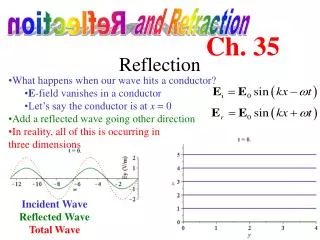
At a discontinuity some of the backwards scattered waves coincide. This is called reflection. Present at all interfaces Reflected waves also form rays. Backscatter
Clear materials also reflect at an interface. About 4% of the light energy is reflected at an air-glass interface. Significant if one side is darker Mirror Glass Photo by Michael Goltz Photo from visit-Chicago-Illinois.com
If a surface is smooth then the reflected rays travel in parallel. This is called specular reflection. Specular Reflection
If the surface is rough then reflected rays travel in different directions. This is called diffuse reflection. Diffuse Reflection
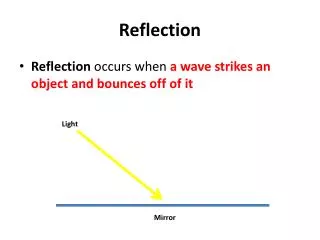
Geometry describes a single ray reflected from a surface. The normal is a line perpendicular to the surface at the point the ray strikes. Angles are measured with respect to the normal. Incident angle qi Reflected angle qr Measuring Reflection
Laws of Reflection • The relationship of the angles are called the laws of reflection. • Incident ray, reflected ray and the normal are all in the same plane • Angle of reflection equals the angle of incidence: θi = θr next