Enhancing 802.11 MAC Performance: Addressing Issues and Introducing an Overlay Approach
This document explores the performance issues associated with the 802.11 MAC protocol, primarily focusing on inefficient backoff mechanisms and the negative impact of slow hosts on faster ones. It discusses potential improvements, including new MAC protocols and an innovative overlay approach (Overlay MAC Layer - OML). The OML aims to enhance resource allocation in multi-hop networks, fairness among nodes, and predictability in communication. Performance measurements from various simulations and real-world tests illustrate the effectiveness of OML in reducing contention and improving throughput.

Enhancing 802.11 MAC Performance: Addressing Issues and Introducing an Overlay Approach
E N D
Presentation Transcript
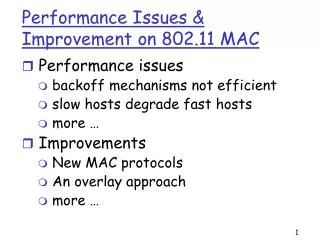
Performance Issues & Improvement on 802.11 MAC • Performance issues • backoff mechanisms not efficient • slow hosts degrade fast hosts • more … • Improvements • New MAC protocols • An overlay approach • more …
Performance Anomaly of 802.11 Martin Heusse, Frank Rousseau, Gilles-Berger Sabbatel, Andrzej Duda LSR-IMAG Laboratory Grenoble, France
Performance of DCF Overall Transmission time (T) : Constant Overhead (tov) : Proportion of useful throughput (p):
Performance of DCF Taking into account collisions and exponential backoff, Overall Transmission Time, T(N), becomes : Time spent in contention tcont(N) :
Performance of DCF Assuming that multiple successive collisions are negligible, Proportion of collisions (Pc(N)) experienced for each packet acknowledged successfully : Proportion (p) of useful throughput obtained by a host:
Performance Anomaly of 802.11b Fast Host: Slow Host: R : transmission rate of ‘fast’ host (11Mbps) r : transmission rate of ‘slow’ host (5.5, 2 or 1 Mbps) tRov : overhead time of ‘fast’ host trov : overhead time of ‘slow’ host
Performance Anomaly of 802.11b Channel utilization by a ‘fast’ host (Uf) : Average time spent in collisions, tjam, is Now, the throughput at the MAC layer of each of the (N-1) ‘fast’ hosts is given by,
Performance Anomaly of 802.11b Similarly for a ‘slow’ host : and,
Performance Anomaly of 802.11b Result : Fast hosts transmitting at a higher rate R obtain the same throughput as slow hosts transmitting at a lower rate r. i.e.
Performance Measurements • 4 notebooks – Marie, Milos, Kea, and Bali • Linux RedHat 7.3 (kernel 2.4.18) • 802.11 cards based on Lucent Orinoco and Compaq WL 110 • Lucent Access Point • Wvlan driver for the wireless card
Performance Measurements • Tools used • netperf – generates TCP and UDP traffic to a target host running netserver. • tcpperf – generates TCP traffic. • udpperf – generates UDP traffic. • Metric: average throughput at each second
Performance Measurements • Hosts with different rates, no mobility, UDP traffic
Performance Measurements • Hosts with different rates, no mobility, TCP traffic
Performance Measurements • Hosts with different rates, real mobility, UDP traffic
An Overlay MAC Layer for 802.11 Networks Ananth Rao Ion Stoica UC Berkeley Mobisys 2005
Problem • 802.11 provides no control over resource allocation • Default allocation policy ill-suited for multi-hop networks • Hidden terminals • Bad fish problem • Forwarders get same share as others A B C D 1M 11M A B C D E A B C D F
Overlay MAC Layer (OML) • Design goals • Efficient • Fair or differentiated allocation • Flexible and low cost • Avoid modifying MAC • Solution: Overlay MAC layer (OML) • No need to change hardware • Directly use interfaces exposed by 802.11 cards • Can control only when to send data to card
Main Idea • Use TDMA-like schedule • Divide time into slots • Allocate slots to nodes according to weighted fair queuing policy • Weighted slot allocation (WSA) • assigns a weight to each node • in every interference region allocate slots proportion to nodes’ weights • Benefits • Achieve any weight allocation • Increase predictability • Reduce packet loss
Weighted Slot Allocation • Decide a winner for each slot w/o communication • Keep track of active nodes • Include current queue length in all packets • Trick: Each node generate a random number on behalf of all nodes in the collision domain (2-hop neighborhood); the highest number wins • H_i = H(n_i, t) ^ 1/w_i
What’s the slot size? • 10 packets of maximum size • Larger than clock synchronization error • Larger than packet transmission time • As small as possible
Which set of nodes to apply WSA? • Ideally node i applies WSA to all nodes that interfere with i • How to determine who interfere with me? • Assume a node can interfere with all nodes within k-hop distance • Only an approximation, not accurate • How to determine interference relationship is an active research!
How to avoid wasting slots? • Inactivity timer • When timer expires and nothing is sent, next highest hash value node can transmit • Set to transmit time of 3 maximum sized packets
Improving OML Efficiency • Amortizing the cost of contention resolution ? • Form groups of N slots • Transmitter in ith slot of a group, gets to transmit in ith slot of the next group with probability p • Node join/leave takes 1/(1-p) slots to converge ? • Modify definition of H_i to inflate node weight if it has received less than its fair share of slots
Evaluation Methodology • Simulation in Qualnet • Implementation in Atheros Madwifi driver + Click router
Summary of Results • Overhead: OML thruput comparable to native 802.11 • Reduced contention and retransmissions • Fairness: Fairness index for OML network much higher • A node’s share = # flows passing thru it • Limitations: Impact of mobility; Interference from native 802.11 clients
Simulation Results • Similar throughput to 802.11 • Control overhead is small
Simulation Results (Cont.) • Improved fairness over standard 802.11 • Weight set to number of nodes in output queue
Summary • Coarse-grained scheduling on top of 802.11: • alleviate inefficiencies of the MAC protocol in resolving contention • overcome the lack of flexibility of assigning priorities to senders • Enables experiment with new scheduling and bandwidth management algorithms
Limitations • Interference from other 802.11 clients • Face incrementally deployment issues • Impact of mobility • Takes some time for newly joined nodes to get its proportional share • How to set weight? • How to know of weights of nodes in interference region (weights can be dynamic)?