Download

1 / 10
110 likes | 254 Vues
This presentation delves into the diverse food culture of the Middle Ages, highlighting how geography and social class influenced dietary habits. It identifies three primary classes: the nobility, clergy, and serfs, each with distinct food preferences and restrictions. While bread was a staple across all social strata, nobles enjoyed lavish feasts and fine wines, while serfs relied on simple barley bread and basic vegetables. The role of dietary restrictions imposed by religion and the use of spices among the wealthy are also discussed, along with unique dishes that reflect the era’s culinary practices.

E N D
Food in the Middle Ages: By Class By AnnaV
The Scope of the Middle Ages • The term “Middle Ages” encompasses not only a lot of time but a lot of land too. In an era when travel was difficult and preservation was hardly existent. Therefore the food and norms vary greatly from region to region • This presentation will cover universal generalizations between regions.
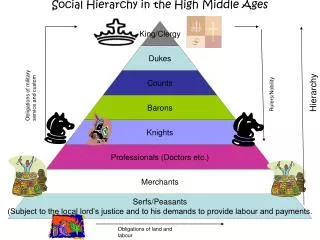
The Classes • There were three classes of people in the Middle Ages • The land owning nobility • The Clergy • And the dirt under their feet--serfs
Generalizations • Bread was very important to every class • Wine was the beverage of choice; beer was only drunk in the North • There were many religious limitations on eating. • For instance, meat was forbidden for a third of the year • Contrary to modern belief, Medieval food was not over spiced or rotten ,and rarely toxic.
The Serfs • The Serfs worked for the nobles on the condition that they would not be killed • Their diets were very basic, not only because they were dirt poor, but also because it was believed that coarser, cheaper food was healthier for people who did a lot of manual labor • Their bread was made out barley. In fact their most of their food was made out of barley. • Their wine was usually second or third pressing white or rose wine • Pork and chicken were the most common meats • Soup was the most common meal • They supplemented their diet with vegetables whenever they could.
The Nobles • The Nobles ate bread made from wheat • And they had first pressing red wine • Nobles liked to have feasts to flaunt their importance • The spectacle was very important. • For instance, poultry was served with a liquor doused rag in its mouth. The rag was then lit on fire • This class enjoyed more international food
The Clergy (Adapted From St. Benedictine’s Rules) • Monks were allowed two meals a day, with two cooked dishes for each meal. • They had about half-pint of wine each • “Flesh meat” was prohibited to all but the weak • Pound of bread a day, regardless of how many meals there were • More might be allotted in proportion to how hard the work had been • However there a frequent cautions against gluttony • It was advised that one monk read through the dinner.
Seasonings • Spices • Due to cost, only the rich ate spices • Common Spices: • Black Pepper • Saffron • Ginger • Cloves • Sugar • Herbs • For everyone else, there were herbs. • Common Herbs: • Parsley • Mustard • Dill • Fennel • Mint
Two Dishes You Might Not Want to Try • Almond Milk: very popular as a substitute for real milk when that was prohibited by the Church, this dish is healthy and tasty. Provided you use sweet, not bitter, almonds • Live Goose: what it sounds like, goose cooked and eaten while it is still living. Undesirable for obvious reasons
Bibliography • Wikipedia.org • A Boke of Gode Cookery.com • The Food Network. • Benedictine’s Rules for monks • THE INTERNET!!!!