Understanding Organism Classification: The Basics of Taxonomy and Species Identification
Classification is vital for scientists to understand and organize the diverse life forms on Earth. This guide delves into the principles of taxonomy, describing how organisms are grouped based on shared characteristics. It explains key concepts such as the dichotomous key, which helps identify organisms through a series of questions, and outlines the eight-level classification system pioneered by Carolus Linnaeus. By understanding how living things are systematically categorized—from kingdom to species—we can better appreciate biodiversity and the relationships among species.


Understanding Organism Classification: The Basics of Taxonomy and Species Identification
E N D
Presentation Transcript
Classification The Big Idea
The Big Idea • Organisms are classified into groups based on their characteristics.
Vocabulary • Classification is putting things into orderly groups based on small characteristics. • Taxonomy is the science of describing, classifying and naming living things.
Vocab. Cont. • Dichotomous Key an aid that is used to identify organisms and that consists of the answers to a series of questions.
Why Classify? • Scientists classify organisms to help make sense and order of the many kinds of living things in the world.
Classification helps scientists answer 3 important questions • How many known species are there? • What are the defining characteristics of each species? • What are the relationships between species?
Imagine you are in a tropical rainforest and must get your own food, shelter, and clothing from the forest. • What do you need to know to survive.
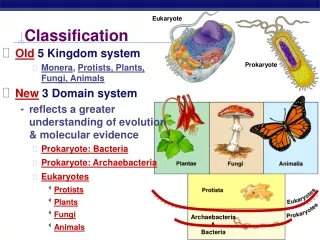
How do scientists classify organisms? • At first organisms were divided into 2 groups Plants and Animals. • Scientist Carolus Linnaeus of Sweden founded modern taxonomy. • Today we use a system of classification that is very similar to that of Linnaeus.
Classification today • Taxonomists use an eight level system to classify living things: • Kingdom, Phylum, Class, Order, Family, Genus and Species
Let’s classify a domestic cat • Kingdom: All animals are in the Kingdom Animalia • Phylum: have a hollow nerve cord. Most have a backbone. Chordata.
Class: Mammalia – have a backbone and nurse their young • Order: Carnivora – have a backbone, nurse their young, have special teeth for tearing meat.
Family: Felidae – have a backbone, nurse their young, have special teeth for tearing meat, have retractable claws • Genus: Felis – these cats cannot roar; they can only purr
Species: Felisdomesticus– Has all the previous traits but it also has unique traits.