Comprehensive Overview of Standard Template Library (STL) in C++
This overview presents the essentials of the Standard Template Library (STL) in C++. The STL consists of a collection of useful abstract data types (ADTs), generic algorithms implemented as class/function templates, and is not a core part of the C++ language itself but a vital component of the C++ standard. It encompasses six main components: containers (sequence and associative), iterators, adaptors, and allocators. Learn about different container types like vectors, deques, lists, and sets, as well as traversing with iterators and utilizing generic algorithms for efficient data manipulation.

Comprehensive Overview of Standard Template Library (STL) in C++
E N D
Presentation Transcript
Standard Template Library (STL) Overview – Part 1 Yngvi Bjornsson
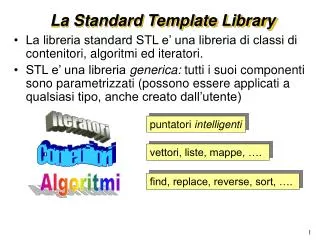
STL • Collection of useful • abstract data types (ADT) • generic algorithms • Implemented as class / function templates • STL is • not a part of the C++ language itself • but a part of the C++ standard!
STL Components • Six main components • Containers • Sequence • Associative • Iterators • Constant/Mutable • Forward/Bi-directional/Random Access • Adaptors • Container / Interator / Function • Allocators • Generic algorithms • Function objects
Containers • Sequence Containers • Arrange data-items into a linear arrangement. • Container types • vector<T> • deque<T> • list<T> • (Sorted) Associative Containers • Fast insert/retrieval of data-items based on keys • Container types • set<Key> multiset<Key> • map<Key,T> multimap<Key,T> • "multi" containers allow multiple items with same key.
Sequence Containers • Vector: • Efficient add/delete back, access/modify any element • Deque: • Efficient add/delete front/back, access/modify any element • List: • Efficient add/del. elements anywhere, access/mod. front/back 5 6 6 5 6 6 5 6 6
#include <list> #include <vector> #include <deque> using namespace std; int main() { // STL Vector can use as an array (grows dynamically!) vector<int> V1(10), V2; for ( int i=0 ; i<10; i++ ) { V1[i] = i; // NOTE: cannot use subscript unless element exists! V2.push_back(i); } for ( int i=0 ; i<10; i++ ) cout << V1[i] << " " << V2[i] << endl; // STL Deque deque<int> D1, D2; for ( int i=0 ; i<10; i++ ) { D1[i] = i; D2.push_front(i); } for ( int i=0 ; i<10; i++ ) cout << D1[i] << " " << D2[i] << endl; // STL List (no subscripting) list<int> L1, L2; for ( int i=0 ; i<10; i++ ) { L1.push_back(i); L2.push_front(i); } for ( int i=0 ; i<10; i++ ) { cout << L1.front() << " " << L2.back() << endl; L1.pop_front(); L2.pop_back(); } }
Iterators • Standard interface of how to traverse elements in a container. • Allows us to write generic algorithms that work for any container! ( … almost) • Iterators behave in a way like pointers • * (dereference), ++, --, ==, !=, +=, -= • Can think of as generalized pointers
Iterators and Containers • The container classes have methods • begin() Returns an iterator "pointing" to first element • end() Returns an iterator pointing after last element • (also rbegin() and rend() for reverse traversal) • Example: • // Displays element of list Llist<int>::iterator il;for ( il=L.begin() ; il != L.end() ; il++ ) { cout << *il << endl;}
Iterator Kind • Kind • Forward iterators • ==, !=, ++, * (dereference) • Bi-directional iterators • -- (additially to forward iterators) • Random access iterators • [], +, -, +=, -= (additionally to bi-directional iterators) • Containers • List (bi-directional), vector and deque (random-access)
Iterator Declaration • Mutable (default): • list<int>::iterator • Constant • List<int>::const_iterator • Reverse (also mutable) • list<int>::reverse_iterator • Constant and Reverse • list<int>::const_reverse_iterator
Generic Algorithm template<typename IterType, typename ElemType> IterType find(IterType first, IterType last, const elemType& value) { for ( ; first != last; ++first) if (value == *first) return first; return last; } vector<int> ivec; vector<int>::iterator it = find(ivec.begin(), ivec.end(), 1024); if (it!=ivec.end()) { …… } // found 1024 in ivec list<string> slist; list<int>::iterator iter = find(slist.begin(), slist.end(), "duck"); if (iter!=slist.end()) { ……} // found "duck“ in slist
Container Adaptors • Container classes implemented on top of the existing containers (adapt their interface) • stack (default container: deque) • queue (default container: deque) • priority_queue (default container: vector) • Can change underlying container class • stack<int, vector<int> > • Note, need space in between > Why?
#include <stack> #include <queue> using namespace std; int main() { // STL Stack stack<int, vector<int> > S; // Changing default container (note '> >', not '>>') for ( int i=0 ; i<10; i++ ) S.push(i); for ( int i=0 ; i<10; i++ ) { cout << S.top() << " "; S.top() = 2 * S.top(); cout << S.top() << endl; S.pop(); } // STL Queue queue<int> Q; for ( int i=0 ; i<10; i++ ) Q.push(i); for ( int i=0 ; i<10; i++ ) { cout << Q.front() << endl; Q.pop(); } // STL Priority Queue priority_queue<int> P; for ( int i=0 ; i<10; i++ ) P.push(i); for ( int i=0 ; i<10; i++ ) { cout << P.top() << endl; P.pop(); } }
Associative Containers • set: • Add/Delete elements to/from set (no duplications) • Can ask of membership (is in set) • map: (associative array) • Add/Delete pairs to/from map (no duplications of keys) • multiset / multimap essentially the same except duplications of keys allowed. a b c d a 1 b 2 c 1 d 0
#include <string> #include <set> #include <map> using namespace std; int main() { // STL set set<string> S; S.insert("hi"); S.insert("how"); S.insert("are"); S.insert("you"); for ( set<string>::iterator is=S.begin() ; is != S.end() ; is++ ) { cout << *is << endl; } // STL map map<string,int> M; M["Hi"] = 0; M["how"] = 1; M["are"] = 2; M["you"] = 1; if ( M.find("how") != M.end() ) cout << "'how' is in map" << endl; for ( map<string,int>::iterator im=M.begin() ; im!=M.end() ; im++ ) { cout << im->first << " " << im->second << endl; // note use of pair } }
Summary • Overview of STL • Containers • Iterators • Some of the containers have • additional methods not covered here • e.g. can splice lists • For complete documentation (and intro): • http://www.sgi.com/tech/stl/