Download
1 / 11
110 likes | 211 Vues
This presentation explores how Taiwan can adopt Regulatory Impact Assessment (RIA) in its policy-making by learning from Uganda's experience with the Poverty Eradication Action Plan (PEAP). Uganda's journey highlights key areas: governance, policy consultation, and implementation challenges. The study contrasts Taiwan's strong governance and institutional frameworks with Uganda's past mistakes, emphasizing the importance of commitment, consistent dialogue, and effective planning. By analyzing Uganda’s challenges, we propose actionable strategies for Taiwan to ensure RIA effectively supports its policy development processes.

E N D
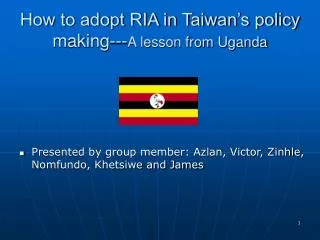
How to adopt RIA in Taiwan’s policy making---A lesson from Uganda • Presented by group member: Azlan, Victor, Zinhle, Nomfundo, Khetsiwe and James
What has Uganda done? PEAP : Uganda is one of the few countries who first developed a Poverty Eradication Action Plan Actions planned under five pillars: • Economic management • Enhancing production, competitiveness and incomes • Security, conflict resolution and disaster management • Good governance • Human development
Do right things V.S. Do things right • Do right things: • Is PEAP a right things to do? • Since 2000,Word Bank and IMF have asked their developing-country clients to prepare Poverty Reduction Strategy Papers(PRSPs), partly inspired by the example the Uganda’s first PEAP.
Do right things V.S. Do things right • Do things right • What is RIA? • A better way for policy making decision, to do things right
Lessons from Uganda to help Taiwan to do thing right • Uganda failed to implement RIA well • Does Taiwan has the same problem if we adopt RIA? What Taiwan can do to avoid Uganda’s mistake?
Government policy and commitment • Uganda: no ongoing commitment • Taiwan: strong governance Institution:RDEC (Research,Development and Evaluaiton Commission )
Policy consultation and dialogue frameworks • Uganda: inadequate consultation and dialogue infrastructure has been a major handicap • Taiwan: consultation mechanism
Competing policy priorities, policy inconsistency and weak planning • Uganda: Competing reform priorities , cause competition for limited resource, capacities and staff time • Taiwan: • Sectionalism: • policy inconsistency: the case of Bayer investment, nuclear power plant
Institutional champions • Uganda: significantly depended on a limited number of key institutional champions, other ministries just sit back • Taiwan: has the trend to delimit responsibility ???????????
Converting support for RIA into the use of RIA in day to day policy-making • Uganda: challenge in Uganda is to convert this initial support and interest in RIA consistently • Taiwan: similar methodology: design-implement-monitor
Conclusion • The more we do thing right, the more we do right thing