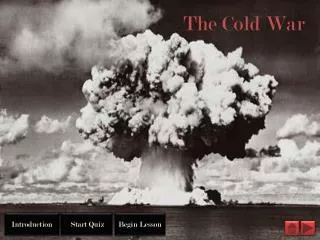

The Cold War
E N D
Presentation Transcript
The Cold War Major events between 1945 - 1950
Lesson Objectives • At the end of this lesson you will blog responses, working in small groups to: • Analyze the different motives of the United States and the Soviet Union at Yalta and Potsdam Conferences • Analyze cultural, historical, economic, and political factors that propelled the US and Soviet Union into the Cold War • Determine how atomic weapons contributed to Cold War
Yalta Conference – Feb. 1945 • Roosevelt, Stalin, and Churchill • Discuss future peace, events at the end of the war in Europe, and the disposition of nation-states after the war • Areas of agreement: • German lands: four zones; Berlin split four ways; USSR in East; U.S., France, and Britain in West • East Asia • Austria • Formation and Participation in United Nations with Security Council: US, Britain, USSR, France, China
Disagreements: • Poland: previous government in exile • Stalin wants Poland • FDR and Churchill want Soviet acceptance of national self-determination and democratic elections in Poland • Stalin agrees to declaration promising free-elections but refused to relinquish control • FDR seen as “selling out” by some historians
Events between Yalta and Potsdam Conferences • Senator Truman: June 1941 • “If we see Germany winning we ought to help Russia and if Russia is winning we ought to help Germany that way let them kill as many as possible . . . .” • President Truman: April 1945 • Soviet Foreign Minister V.M. Molotov stormed out of White House after reported confrontational meeting with Truman • May 1945: Truman and cabinet • Adopt policy abruptly ending lend-lease to Russia, criticizing Soviets for taking over E. Europe countries, and condemned them for actions in E. Germany
Potsdam Conference: July 1945 • Participants: Truman, Stalin, Churchill then Attlee • Truman tries to avoid use of Atomic Bomb • Statement to Japan: future of emperor open, spare civilians/punish war criminals, free Democratic Japan after time of occupation • Potsdam Declaration: July 26, 1945 • Demanded Japanese surrender or face “prompt and utter destruction.”
Germany after surrender • East Germany • Soviets take factories and confiscate state property as war bootie • Also demand industrial equipment from W. Germany • Take over large farms and divide among smaller farmers • Unpunished rape of women • “free” elections under Communist control
West Germany • 1946 – Western powers change from punishment to reconstruction • Aware of Soviet strength in East • Economic burden of occupation • 1947 – Britain, France, and US unite zones in Germany and Berlin to become West Germany • Continued with reconstruction and union of zones despite Stalin’s statements of concern • Politics model a parliamentary democracy • Germany becoming “front-lines” between East and West
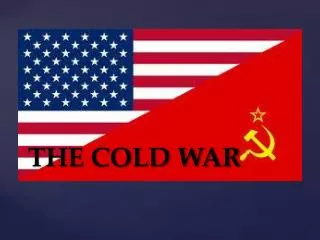
Truman Doctrine • US aid to anti-communist forces in Greece and Turkey • Create public consensus so Americans would agree to end isolationism and fight Cold War • Journalist Walter Lippmann popularized the term cold war in 1947 with Cold War • Seen as containment policy against communists
Stalin’s Response to Containment • Increased control in nation-states in his sphere by mobilizing other communist to political opposition to the West • Formed Communists Information Bureau • Increased Soviet control of communist parties and governments • Eliminated power of non-communist groups in Eastern Europe • Motivated resurgence of Communist guerillas in Czechoslovakia, China, and Greece
Marshall Plan • Helped foreign relations between W. European states and U.S. • Goals: • Immediate: economic recovery for war-torn nations • Long term: achieve social and political democracies • Conditions: • Nation states had to coordinate efforts and make public economic needs
Berlin Blockade • Allies: rebuild W. Germany • Stalin: stop unification and halt economic recovery • Underestimated power of air transport • Soviets opened roads May 1949 after 11 months
North Atlantic Treaty Organization 1949 • Formed by Truman with Canada and major states of Western Europe • Agreed to form alliances to help each other under times of aggression • Presumed enemy….. • Principal defender….
Blogging about it all • Open website www.rockinrevolution.pbwiki.com • Log-in with password: moravian • Link to page for US History Lesson • In groups of 2 or 3 discuss events and post comments: • What were the motives of US and Soviet Union? • What cultural, economic, and political factors led U.S. and Soviets into the Cold War? • How did atomic weapons affect the Cold War?