SlideServe
Menu
Préférences
© SlideServe · v2026

Don’t lose your marbles S.T.E.M. Challenge physics & engineering Roller-coaster design

stacie avatar
14 diapositives · 1.1K Views · Jul 08, 2014

Don’t lose your marbles S.T.E.M. Challenge physics & engineering Roller-coaster design. What do we know about roller-coasters already?. What you need to know…. Roller-Coast Engineering: Branch of engineering concerned with designing, constructing, and testing roller-coaster cars and paths
Don’t lose your marbles S.T.E.M. Challenge physics & engineering Roller-coaster design - slide 1
01 / 14Don’t lose your marbles S.T.E.M. Challenge physics & engineering Roller-coaster design
1 / 17

Télécharger la présentation

Don’t lose your marbles S.T.E.M. Challenge physics & engineering Roller-coaster design
Une image / un lien ci-dessous est fourni (tel quel) pour télécharger la présentation

Politique de téléchargement : le contenu du site vous est fourni TEL QUEL pour votre information et votre usage personnel ; il ne peut être vendu, concédé sous licence ni partagé sur d’autres sites sans l’accord de son auteur.Le contenu vous est fourni TEL QUEL, pour votre information et votre usage personnel uniquement. Téléchargez la présentation en cliquant sur ce lien. Lors du téléchargement, si vous ne parvenez pas à télécharger une présentation, l’éditeur a peut-être supprimé le fichier de son serveur.Pendant le téléchargement, si vous ne parvenez pas à obtenir une présentation, le fichier a peut-être été supprimé par l’éditeur.

F I N

Plus de contenu associé

Transcription de la présentation
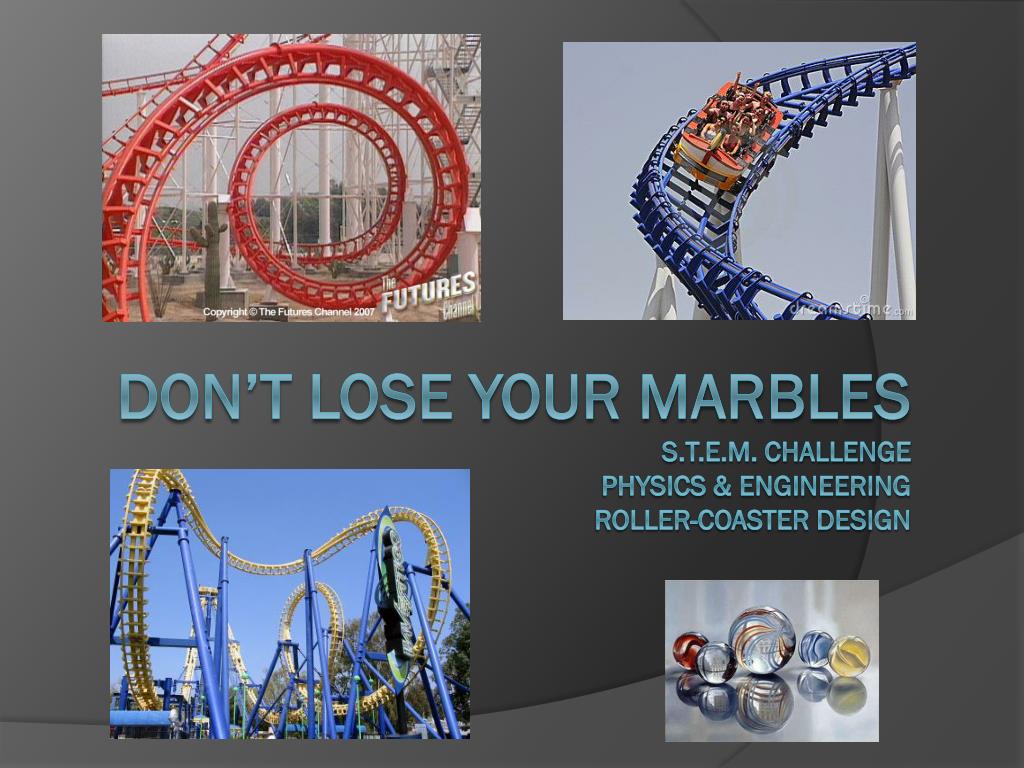
  1. Don’t lose your marblesS.T.E.M. Challengephysics & engineeringRoller-coaster design

  2. What do we know about roller-coasters already?

  3. What you need to know… • Roller-Coast Engineering: • Branch of engineering concerned with designing, constructing, and testing roller-coaster cars and paths • Create a ride that is thrilling, fun, and safe • Testing the coasters means the engineers have to ride the coasters! • Fun job!

  4. What you need to know… • When moving up hill, cars are moving against pull of gravity • Cars must be pulled up highest hill first • Potential energy (stored energy) • Greater weight and greater height means greater potential energy

  5. What you need to know… • The first hill is the source of energy for rest of the ride • Inertia • Object in motion stays in motion, object at rest stays at rest • Kinetic energy (moving energy) • As gravity pulls cars down track potential turns to kinetic

  6. What you need to know… • Roller-Coaster loops • Centrifugal Force • Force pushing towards the center of the loop • Centripetal Force • Force pushing away from the center of the loop • Centrifugal and centripetal forces balance each other

  7. Here’s the challenge… • You will work in teams to design and build a freestanding structure that has a track which a marble can travel • You will be awarded points for the structure • 1 point for each centimeter of height • 5 points for each 90 degree angle turn on track • 1 point for each marble to travel entire track • 5 points for marble that travels track and stays in container at the end of track

  8. Here’s the challenge… • Materials- • Straws $5.00 • Q-tips $2.00 • Index cards $2.00 • Pencils $5.00 • Cup $5.00 $200 Budget • Team Jobs • Materials manager • Checker • Encourager • Recorder • Reporter/Banker • Tools/Supplies- • Glue • Tape • Crayons • Scissors • Ruler

  9. Try to earn as many points as you can for your structure… You get 5 marble Trials…

  10. It’s time to get rolling… • Stop and Think!!!! • Potential energy is the stored energy an object has due to position or condition • The higher an object is raised, the more potential energy it has • The cars on the highest hills have the most potential energy • Centripetal force is force of an object moving in a circular path • Centripetal force is directed inward toward the center of the circular path

  11. Other marble roller-coasters…

  12. If they can do it, so can you…

  13. Question that… • Was your structure the best solution? • What could you have done differently? • What math skills did you use in this challenge? • Was your group under budget? • What made structures and successful or unsuccessful? • How could your structure have earned more points?

  14. How can we apply what we learned from this challenge to real life? How did we apply what we learned from other S.T.E.M. challenges to this challenge? Tammy Reid Bush- Bioengineer How can we apply what we learned from this challenge to a S.T.E.M. career?