Effects of Climate and Land Use on Soil Respiration in Northern Wisconsin (1972-2001)
This publication explores the impact of climate change and land use on soil respiration across northern Wisconsin from 1972 to 2001. It examines the effects of land-use changes and forest management on ecosystem respiration and carbon fluxes within various forest ecosystems. The studies assess moisture sensitivity, age-related changes, and seasonal variations in carbon exchange, highlighting how these factors influence soil respiration and overall ecosystem health. By providing insights into forest carbon dynamics, this research aims to enhance understanding of forest management and climate interactions.

Effects of Climate and Land Use on Soil Respiration in Northern Wisconsin (1972-2001)
E N D
Presentation Transcript
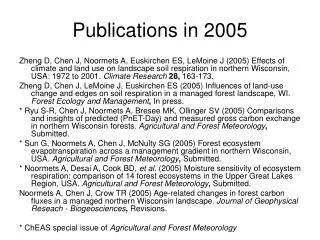
Publications in 2005 Zheng D, Chen J, Noormets A, Euskirchen ES, LeMoine J (2005) Effects of climate and land use on landscape soil respiration in northern Wisconsin, USA: 1972 to 2001. Climate Research28, 163-173. Zheng D, Chen J, LeMoine J, Euskirchen ES (2005) Influences of land-use change and edges on soil respiration in a managed forest landscape, WI. Forest Ecology and Management, In press. * Ryu S-R, Chen J, Noormets A, Bresee MK, Ollinger SV (2005) Comparisons and insights of predicted (PnET-Day) and measured gross carbon exchange in northern Wisconsin forests. Agricultural and Forest Meteorology, Submitted. * Sun G, Noormets A, Chen J, McNulty SG (2005) Forest ecosystem evapotranspiration across a management gradient in northern Wisconsin, USA. Agricultural and Forest Meteorology, Submitted. * Noormets A, Desai A, Cook BD, et al. (2005) Moisture sensitivity of ecosystem respiration: comparison of 14 forest ecosystems in the Upper Great Lakes Region, USA. Agricultural and Forest Meteorology, Submitted. Noormets A, Chen J, Crow TR (2005) Age-related changes in forest carbon fluxes in a managed northern Wisconsin landscape. Journal of Geophysical Reseach - Biogeosciences, Revisions. * ChEAS special issue of Agricultural and Forest Meteorology
Ongoing and planned efforts Physiological control of ecosystem fluxes • Ecosystem- and leaf-level gas exchange: comparison of capacities, sources of discrepancies • Fluxes in ecosystem edges Effects of man-made disturbance • Recovery of C fluxes after disturbance • Regulation of ecosystem respiration Landscape integration of carbon and water cycles • NEP changes over succession • Ecosystem water cycle • Landscape-level PnET modeling • Effects of land-use change on landscape C balance
Regulation of ecosystem respiration Asko Noormets The University of Toledo
Regulation of ER - AFM summary Ts explained ~43% of variation in ER (range 8-82%) SWC explained 8% (range 0-21%) • M-sensitivity occurred in: • all age groups • both forest types (hardwoods & conifers) • M-sensitivity was: • Greatest in Willow Creek & Sylvania sites • Intermediate in IRP, IHW, YJP-Baraga & YHW • Not significant in other sites (12 site-years)
Moisture-sensitivity of ER Moisture response was: • non-linear • correlated with well-defined moisture optimum • correlated with bi-modal SWC distribution
What are the other factors? • Substrate availability? • Auto- vs. heterotrophic? • Chemical vs. physiological control?
Seasonality of ER • Seasonal cycle of ER parallels the cycle of soil moisture (most mature stands) • Seasonal cycle in ER goes against the cycle of soil moisture (some young stands)
Seasonality of ER • Seasonal cycle of ER parallels the cycle of soil moisture (most mature stands) Hypothesis: Moisture-limited ER • Seasonal cycle in ER goes against the cycle of soil moisture (some young stands) Hypothesis: Substrate-limited ER
Phenology: physical vs. physiological control&auto- vs. heterotrophic processes
Ecosystem ER • Bounds of physiological regulation • Partitioning the limitation to other factors • Substrate dynamics • ChEAS-specific • Assemble regional • C budget 2. General Mechanistically explain ER
ChEAS-wide activities • Comparison of flux processing algorithms (Cherrey, Saliendra et al.) • Comparison of respiration models • Comparison of gapfilling procedures
Growing season C budget GEP NEE ER