The Scientific Method
The Scientific Method is a systematic approach to problem-solving that everyone employs daily, often without realizing it. From asking where your shoes are to determining which pain reliever works best, the method provides a structured way to find answers. This guide outlines the six essential steps: identifying a problem, conducting research, formulating a hypothesis, carrying out an experiment, making observations, and drawing conclusions. By following these steps, you can effectively tackle both big and small challenges in life and learn valuable lessons along the way.

The Scientific Method
E N D
Presentation Transcript
The Scientific Method • What is it? • Who uses it? • Why should I care?
Everyone uses it everyday! • Yes! Even you!
It is a way to solve problems! BIG or small
Any of these sound familiar? • Where are my shoes? • What class do I have next? • How do I solve that math problem? • Which deodorant works the best? • Which pain reliever works the best? • What is the cure for cancer?
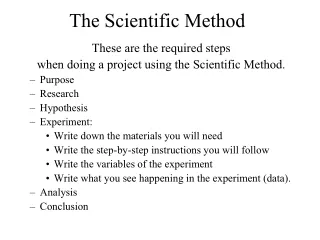
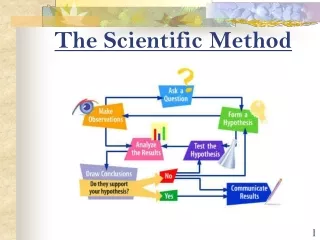
There are SIX steps to the Scientific Method: • Problem/Question • Information/Research • Hypothesis • Experiment • Observations/Analysis • Conclusion
By following these steps in order, you will learn about your problem. • Notice the IN ORDER part. It is very important!
1. Problem/Question • This is the problem you are trying to solve or the question you are trying to answer. • Try to narrow it down and be specific.
2. Information/Research • Has someone tackled this problem before? • If not, gather information about your question/problem: • books • magazines • experts • past experiences
2. Information/Research • Valid Internet sites • Check date when site was last updated • Who put the page together? • Who is responsible for the information?
3. Hypothesis • The hypothesis is an educated guess about the relationship between the independent and dependent variables. • This is what you think the answer is based upon the information you gathered • It should be in form “If (independent), then (dependent).
3. Hypothesis • Independent Variable • The independent, or manipulated, variable is a factor that is intentionally varied by the experimenter. • Dependent Variable • The dependent, or responding, variable is the factor that may change as a result of the changes made to the independent variable. • This is the expected outcome!
4. Experiment • The actual experiment is broken into two parts: • Materials • A list of equipment that you will need for the experiment. • Procedure • A list of instructions that you need to follow for the experiment. (Should be detailed!)
4. Experiment • Control Group • In a scientific experiment, the control is the group that serves as the standard of comparison. • The control group may be a “no treatment” or an “experimenter selected” group. • The control group is exposed to the same conditions as the experimental group except for the variable being tested.
4. Experiment • Constants • The constants in an experiment are all of the factors that the experimenter attempts to keep the same. • Trials • Trials refer to the replicate groups that are exposed to the same conditions in an experiment. • You should do a minimum of 3 trials.
5. Observations/Analysis • Observations • Collection of information and data from the experiment. • It may be in the form of charts, graphs, or written work. • This is WHAT HAPPENED!
5. Observations/Analysis • Analysis • This is an explanation of your observations. • It may involve analyzing your graphs or charts in order to look for patterns to help you answer your question. • It can even mean putting your measurements into a mathematical equation to get an answer.
6. Conclusion • What did you find the answer to your was? • It should state whether you accept or reject your hypothesis. • This does not necessarily mean you “proved” something--just that your analysis supports your hypothesis. • It is OK if it turns out your hypothesis is not correct. You learned!!!!!! • It may lead to another experiment.
Report Your Findings! • Something that is very important but not officially part of the scientific method is to report to others your findings. • You will help others learn!
Common Mistakes • Do not change your hypothesis throughout the experiment. • Do not rule out and ignore observations and data that do not support your hypothesis.
Let’s put our knowledge of the Scientific Method to a realistic example that includes some of the terms you’ll be needing to used and understand.
Problem/Question • John watches his grandmother bake bread. He asks her what makes the bread rise. • She explains that yeast releases a gas as it feeds on sugar.
Problem/Question • John wonders if the amount of sugar used in the recipe will affect the size of the bread loaf.
Information/Research • John researches the areas of baking and fermentation and tries to come up with a way to test his question.
Hypothesis • After talking with his teacher and conducting further research, John comes up with a hypothesis: • If more sure is added, then the bread will rise higher.
Variables • Independent Variable • John is going to use 25 g, 50 g, 100 g, 250 g, and 500 g of sugar in his experiment. • Dependent Variable • The size of the bread loaf.
Control Group • Because his grandmother always uses 50 g of sugar, John is going to use that amount in his control group.
Constants • other ingredients to the bread recipe • brand of ingredients • rise time • air temperature and humidity where the bread is rising • type of pan used • oven used • cooking time
Experiment • John writes out his materials and procedure for his experiment in his journal. Trials • John is going to test each sugar variable 3 times.
Observations/Analysis • John comes up with a table so that he can record his data. • John gets all of his materials together and carries out his experiment.
Size of Bread Loaf (cm3) Trials Observations/Analysis
Observations/Analysis • John examines his data and notices that his control group worked the best in his experiment, but not significantly better than 100 g of sugar.
Conclusion • John rejects his hypothesis, but decides to re-test using sugar amounts between 50 g and 100 g.
Size of Bread Loaf (cm3) Trials Observations/Analysis
Conclusion • John finds that 70 g of sugar produces the largest loaf. • He accepts his new hypothesis.