Understanding Gamma-Ray Bursts and Hypernovae: Insights from Postnov's Research
590 likes | 714 Vues
This document presents an overview of gamma-ray bursts (GRBs) and hypernovae, discussing their properties, associations, and implications in astrophysics. It highlights key developments in GRB research from 1967 to the present. The text delves into the energy release mechanisms, their association with supernovae, and the impact of these cosmic phenomena on surrounding plasma. Key findings from various observational campaigns, including afterglow studies and spectral analyses, are presented, aiming to clarify the nature and origins of GRBs and potential links to hypernova events.


Understanding Gamma-Ray Bursts and Hypernovae: Insights from Postnov's Research
E N D
Presentation Transcript
Gamma-ray bursts and hypernovae Konstantin Postnov Sternberg Astronomical Institute Moscow Erice-2004, July 6, 2004
Outlook • Introduction • GRB as superstrong cosmic explosions • Association with supernovae – a critical view • Thermal effects in ambient plasma • Conclusions
BATSE rate ~1 per day No repetions, full isotropy
`Brief course’ of history of GRBs • 1967- Discovery by American military Vela satellite 1973 – Declassified for scientific community End of 1970s – `Konus’ experiments onboard Russian Veneras (E.P.Mazets et al) • 1991-2000 – `BATSE’ (CGRO) era. Largest homogeneous data (a few thousands) on GRBs. Debates on galactic vs extragalactic origin • 1997-… Afterglow era. Discovery of afterglows in X-ray (BeppoSAX, 1997), optical, radio. Triumph of cosmological model for (long) GRB origin. Multivawelength GRB astronomy 1998 – possible association of GRB980425 with nearby peculiar type Ic SN1998bw. Start of hypernova era (?)
Observed: Duration: 0.1-1000 s Fluence: S~10-7-10-3 erg/cm2 Spectrum: nonthermal, 10keV-100 MeV Variability: high, 1-10 ms Rate: 1 per day Location: z=0.17-4.5, (but 980425 z=0.0085), star-forming galaxies Associated events: X-ray (~100%), optical (~70%), radio (~50%) afterglows F(t)~t-αα~1-2 + Environment signatures: transient X-ray em./abs. lines, metal rich material Derived (for long GRBs only!): Isotropic energy release Eγ=4πdl2/(1+z) ~1051 -1054 erg (but 980425 ~1048) Evidence for jets from afterglow breaks θj~0.01-0.1 Points to ‘standard’ energy release ΔE~1050-1051erg equally shared in kinetic energy and radiation Photon energy correlations vFν~Eiso Association with SN Ib/c General properties
GRB spectra: Two power laws smoothly joined together (Band et al 1993): Slopes α, β and peak energy Epeak vary with time
Generally, spectrum gets softer: ...but not always:
…and even gets harder:GRB 941017 (Gonzalez et al. 2003) EGRET-TASC detection Duration: ~150 s A new, very hard component appeared: E2 FE~E1, Epeak>200 MeV Signals hadronic component (UHECR) with subsequent photomeson interactions? (Dermer & Atoyan,2004)
Amati et al. (’02,’03): Eiso-z, Ep-Eiso correlations 22 events with known z and spectra: Lg Epeak~0.45 lg Eiso Are older GRB more energetic?
Explanation of GRB spectra (not fully satisfactory…) Standard synchrotron shock model (SSM): Optically thin synchrotron radiation by energetic electrons left to radiate without further acceleration. Electrons are accelerated by the Fermi mechanism in relativistic shocks created by the “central engine” (dN/dE~E-p, p~2.2-2.3) BUT: many individual GRB do not fit this! Additional acceleration, IC, change in electron energy index p with time, etc., etc., etc. are invoked
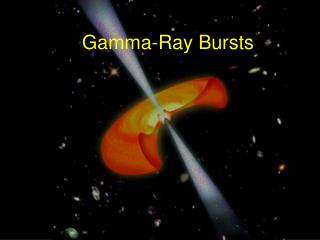
Basic model: ultrarelativistic (Γ>100) jets associated with hyperstrong (1051 erg) explosion (a “hypernova”)
Term “hypernova” introduced by B.Paczynski (1998) according to energy release in an explosive cosmic event • Nova (thermonuclear explosion on white dwarf surface) ΔE ~ 10-9Mc2~1045erg galactic rate~ 1 per a few year • Supernova (core collapse of massive star, SNII,Ib,Ibc or th/n explosion of a WD with MCh~(mPl/mp)3mp~ 1.3 M) ΔE ~ 10-1Mc2~1053erg (~binding energy of neutron star, mostly in neutrino) kinetic energy ~1050erg (~binding energy of stellar envelope) galactic rate~ 1 per a few 10s years ●Hypernova (core collapse associated with black hole formation? Requires the most extremal conditions e.g.B~1015G, rapid rotation, etc.) ΔEγ~1051-52erg kinetic energy >1051erg galactic rate~ 1 per a few 104-106 years
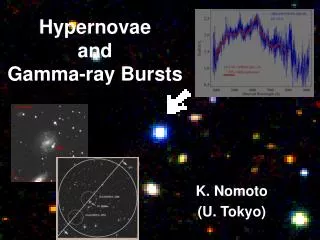
Evolution of massive stars: M<25 M neutron star M>25 M black hole: Hypernova MNi>0.1 M Ekin>1 foe Faint supernova Nomoto et al.2004
Fireball models for GRBs • Rees & Meszaros (1992, 1994…) Recent review: Piran 2004 • Thermal energy of explosion is converted to kinetic energy of thin baryon shell with ultrarelativistic speed (Γ>100) to avoid compactness problem and explain non-thermal spectra • GRB is produced by internal (most likely) shocks within the expanding shell, or by external shock in inhomogeneous ISM. • Internal shocks GRB itself, external shock in ISM X-ray, optical, radio emission of the GRB `afterglow” • Initial interaction of GRB ejecta Reverse shock propagating inward and decelerating fireball ejecta. Erases the memory of the initial conditions. Expansion approaches self-similarity (Blandford & McKee solution, 1976) ΓBM~r-3/2 (simply from E0~(4π/3)r3n0 mpc2Γ2 ) • Parameters: E0, no (const or 1/r2),Γ0, p, εB, εe
ES RS IS Γ2> Γ1 ? Afterglow GRB
Optical afterglows (synchrotron emission from relativistic blast wave in ISM) Early: reverse shock in the ejecta 990123 Late: external shock in ISM 021211 Breaks in ag lc: decelerated jet
Jet beaming effect in the GRB light curves Θ~1/Γ(t)~t3/8 θ0 Γ(r)~r-3/2~t-3/8 t~r/Γ2 r Emitting area: A~r2θ2~r2/Γ2~Γ4 t2/Γ2~t10/8, θ<θ0,t<tj A~r2θ02~Γ4t2~t1/2, θ>θ0, t>tj Θ(tj)=θ0 A increases slower after t>tj
Observed emission~(emitting area)x(specific intensity) For SSM, I~(B2γe2)’Γ~(εBΓ2)(εeΓ2)Γ~Γ5~t-15/8 so F(t<tj) ~ AxI ~t10/8t-15/8 ~ t-5/8 F(t>tj) ~ t1/2t-15/8 ~ t-11/8 θ0=0.16(n0/E0,iso)1/8(tj/days)3/8 Eγ=E0,iso(θo2/2) E0,iso=4πdl(z)2S/(1+z)
Evidence for associated SNe • GRB980425 and peculiar type Ib/c SN 1998bw in nearby galaxy ESO184-g8 (z=0.0085)
Special cases: GRB 030329 – nearest (z=0.168), brightest (S~10-4erg/cm2) Host: a SMC-like star-forming galaxy
SN 2003dh signature in light curve? Difficult to directly accommodate!
GRB030329: but earliest optical spectra (BTA 6m telescope, Sokolov et al. 2003) difficult to explain by shock breakout as pre-SN must be compact!
Optical variability and polarisation suggests structured environment Greiner et al. 2003
List of GRB/SN associations +s (from Dar 2004)
W49B – a hypernova remnant? (Keohane et al. 2004) red: molecular hydrogen 2.12μ (Palomar Hale WIRC) green: 1.64μ FeII (Palomar Hale WIRC) blue: Fe Kα (Chandra). No NS. HN explosion in a molecular cloud a few thousand yrs ago?
Clues from radio observations • Radio scintillations in ISM: Fresnel radius ~5 µasdirect measurement of angular size evidence for relativistic motion (970508, 030329) • Vapp ~4c Frail et al. 1997
Radio observations of GRB030329 (Taylor et al 2004) • Directly reveal apparent superluminal expansion v~3-5c, in accord with relativistic blast wave model for GRB afterglows • Inconsistent with cannonball model prediction for plasmoid superluminal motion (Dado et al 2004) (NB: general problem for CB model is absence of rapid radio diffractive scintillations in GRB030329, though the expected anglular size of plasmoids ~0.01 µas << Fresnel (5 µas ) scale)
But: radio luminosities of GRB and SN1b/c are strongly different (Berger et al.2003)
SN/GRB rates SNIbc in spiral galaxies: 0.2/100yrs/1010L(B) Local univesre: ~ 108L(B) Mpc-3 SNIbc rate ~ 2 104Gpc-3 GRB rate: ~250 Gpc-3 (factor 3-10 uncert. due to collimation) Only a few percent of SNIbc can be associated with GRBs (unlike CB model). Additional conditions (e.g. binarity etc.) must be imposed on the progenitors
‘Standard energy’ issue • Postnov, Prokhorov and Lipunov 1999, 2001 (idea): • Standard explosions ΔE ~ 5x1051 ergs • Structured jets Frail et al. 2001 – standard energy from jet-corrected afterglow observations. Berger et al. 2003 – structured jets from radio calorimetry of GRB 030329, 980425
Jet-corrected energy release (Frail et al) Beaming-correction factor for the rate/energy ~30-200
Recent discoveries : Light echo on dust for GRB 031203 (loc. INTEGRAL, X-ray rich)
HETE2: GRB-X-ray rich-XRF (Lamb et al. 2003) Apparently continuous transition GRB=>X-ray rich=>XRF
XRF 020903 host galaxy spectrum Z=0.251 Star-forming galaxy
Thermal effects in ambient plasma(Kosenko, Blinnikov, Sorokina, PK, Lundqvist 2001, 2002) Bisnovatyj-Kogan & Timokhin 1997 First consideration of environmental effects
Fading X-ray emission lines in 011211 Reves et al – XMM observations of fading (~10 ks) emission lines Kosenko et al 2002 – thermal cooling of plasma clouds heated by GRB N~106 1-3AU-sized clds ne~1011 cm-3 within 0.1 pc are needed