Download
1 / 22
220 likes | 327 Vues
This document explores the dynamics of hypernovae and gamma-ray bursts, with a focus on SN 1998bw. It discusses the characteristics of hypernova candidates, their kinetic energy ranging from (5-10) × 10^51 ergs, and the spectral features of type Ic supernovae lacking hydrogen and strong helium. Key models, light curves, and nucleosynthesis processes are detailed, shedding light on massive stellar explosions and their implications for cosmic nucleosynthesis. The document also addresses the significance of aspherical explosions and the formation of black holes.

E N D
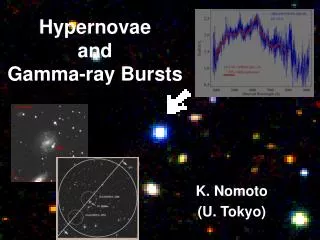
Hypernovae and Gamma-ray Bursts K. Nomoto (U. Tokyo)
SN 1998bw Hypernova CandidatesEkinetic > (5-10)×1051ergs GRB 980425
Spectra of Supernovae & Hypernovae Ic: no H, no strong He, no strong Si SiII Ia O Ca He Ib Hypernovae: broad features blended lines “Large mass at high velocities” Ic 94I 97ef Hyper-novae 98bw
CO Star Models for SNeIc H-rich He 56Fe C+O 56Co MC+O Si 56Ni Fe Collapse • ~ [dyn• diffusion]1/2 ~• 1/2 Mej R V R c Parameters [Mej, E, M(56Ni)] Light Curve Spectra E Mej ½Mej¾E -¼ 56Ni E Mej3
Spectral Fitting: SN1997ef Iwamoto et al. 2000 Too Narrow Features Normal SN (E51=1) Small Mej Hypernova (E51=20) Large Mej at High Vel. Broad Features
Light curves of Hypernovae & SNeIc log L (erg/s) Radioactive Decay 56Ni 56Co 56Fe 43 98bw&CO138 42 97ef&CO100 41 94I &CO21 0 50 100 t (days)
Bolometric Light Curves SN 2003dh Mej=8M E=3.8×1052ergs M(56Ni)=0.35M SN 1998bw COMDH SN 2002ap SN 1997ef Mazzali et al (2003)
Type II-P SN 1997D Very narrow lines. V < 1000 km s-1. EK=1-4×1050ergs. V~1000km s-1 2002gd, 1999br Faint M(56Ni)~2×10⁻³M (Turatto, Mazzali, Young, Nomoto 2002)
Turatto, Mazzali, Young, Nomoto, Iwamoto et al. (1998) SNⅡ 1997D:Faint SN m-M=30.64 (NGC1536) 1987A LBOL 1997D Mms~20M M(56Ni) 0.07M 0.002M 1987A 1997D Mms~ 25-30MR ≤ 300R E~4×1050erg narrow lines
Supernovae/Hypernovae Nomoto et al. (2003) EK Failed SN? 13M~15M
M(56Ni)/M Nomoto et al. (2003) [/Fe]≫0
SNe in Binary Systems Single M1~M2 ”Conservative” M1»M2 ”Non-Conservative” 2 1 2 1 Spiral-in RSG Rapid Rotator SNII Wolf Rayet (WN, WC) He, C+O Star SNIb/c ? SNIb/c Hypernovae?
McWilliam, Ryan, Spite, Co Cr trend [Fe/H] [Fe/H] Mn Zn
Hypernova Nucleosynthesis (1) M(Complete Si-burning) (Zn, Co)/Fe (Mn, Cr)/Fe Fe/(O, Si) (2) More ‐rich entropy Zn/Fe 64Ge Ti/Fe (3) More O burns (Si, S, Ca)/O Low energy High energy
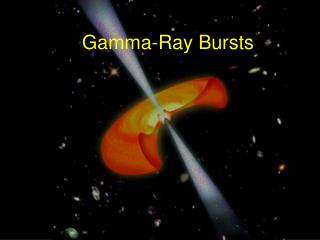
Jet-Induced Explosion Rotating Black Hole + Accretion Disk K. Maeda, 2003
Collimated jets (Z) + Bow shock (All direction) M Lateral expansion Radial Velocity/c Hydrodynamics R/1010cm
Jet-induced Explosion Maeda & Nomoto (2003), astro-ph/0304172 E51=10, MBH(final)=6M, M(56Ni)=0.1M, MCO=14M 0.04 0.04 0.7 s 1 Outflow Inflow (Fallback) 0 0 0 1.5 s R/1010cm
[OI] 6300A 56Fe 16O Interpretation as an Aspherical explosion FeII] 5200A Observation Spherical 15 deg Aspherical Maeda et al. 2002
Element Distribution Bipolar Explosion Model Zn Zn Zn Zn Mn
Spherical 40M, E51=1 Jet 40M, E51=10 [Cr/Fe] [Mn/Fe] Jet 25M, E51=7 Spherical 25M, E51=1 [Co/Fe] [Zn/Fe]
UN2003 Co Cr 15M, E51=1 25M, E51=30 (Hypernova) Mn Zn
Origin of Hypernovae and Gamma-Ray Bursts Hypernovae • High Energy: E>1052erg • Massive: Mms>20-25M, typically 30-40M Black Hole forming Supernovae • Aspherical (Jet-induced) Explosions • Spectra, Light curves, Polarization Rotating Black Hole + Accretion Disk • Type Ic SNe: C+O stars Mergers in Binaries First Stars ? • Hypernova Nucleosynthesis Abundance Patterns of Extremely Metal-Poor Stars