
SlideServe
Menu
Préférences
© SlideServe · v2026

Age Differences in Financial Game Performance

suki avatar
1 diapositives · 117 Views · Jul 19, 2014

Investigating how age impacts financial decision-making in games with older and younger adults, exploring motivational factors and cognitive variables.
Age Differences in Financial Game Performance - slide 1
01 / 1Age Differences in Financial Game Performance
1 / 17

Télécharger la présentation

Age Differences in Financial Game Performance
Une image / un lien ci-dessous est fourni (tel quel) pour télécharger la présentation

Politique de téléchargement : le contenu du site vous est fourni TEL QUEL pour votre information et votre usage personnel ; il ne peut être vendu, concédé sous licence ni partagé sur d’autres sites sans l’accord de son auteur.Le contenu vous est fourni TEL QUEL, pour votre information et votre usage personnel uniquement. Téléchargez la présentation en cliquant sur ce lien. Lors du téléchargement, si vous ne parvenez pas à télécharger une présentation, l’éditeur a peut-être supprimé le fichier de son serveur.Pendant le téléchargement, si vous ne parvenez pas à obtenir une présentation, le fichier a peut-être été supprimé par l’éditeur.

F I N

Plus de contenu associé

Transcription de la présentation
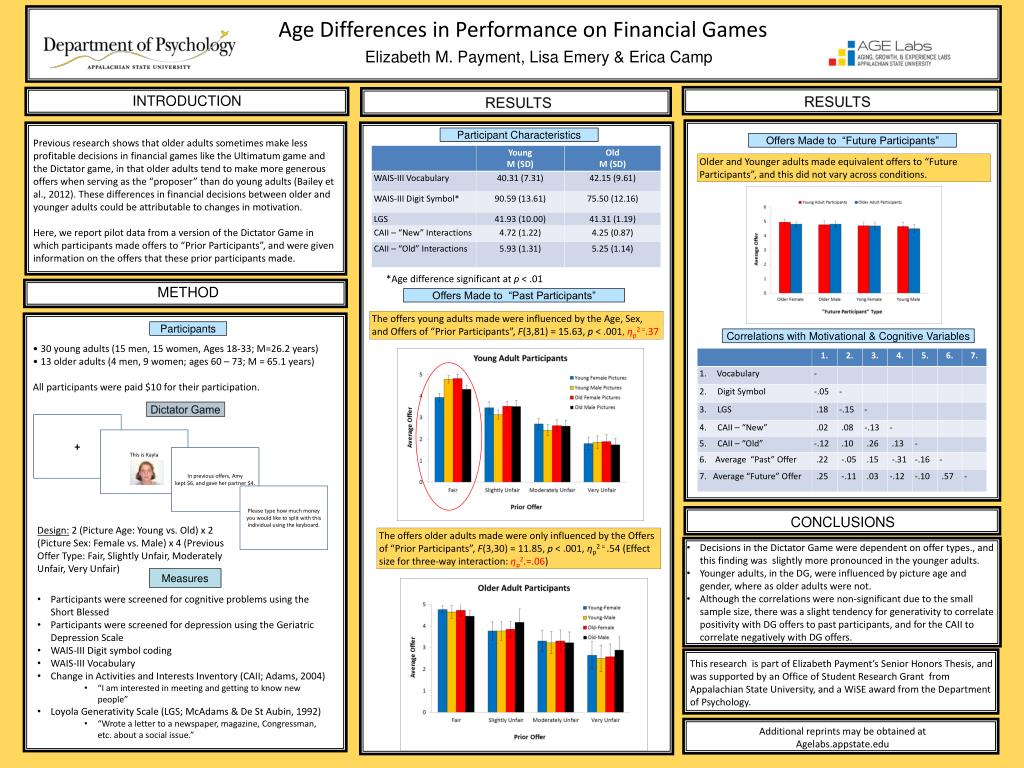
  1. Age Differences in Performance on Financial Games Elizabeth M. Payment, Lisa Emery & Erica Camp INTRODUCTION Participant Characteristics Offers Made to “Future Participants” • Previous research shows that older adults sometimes make less profitable decisions in financial games like the Ultimatum game and the Dictator game, in that older adults tend to make more generous offers when serving as the “proposer” than do young adults (Bailey et al., 2012). These differences in financial decisions between older and younger adults could be attributable to changes in motivation. • Here, we report pilot data from a version of the Dictator Game in which participants made offers to “Prior Participants”, and were given information on the offers that these prior participants made. Older and Younger adults made equivalent offers to “Future Participants”, and this did not vary across conditions. METHOD *Age difference significant at p < .01 Correlations Offers Made to “Past Participants” The offers young adults made were influenced by the Age, Sex, and Offers of “Prior Participants”, F(3,81) = 15.63, p < .001, ηp2 =.37 Correlations with Motivational & Cognitive Variables Participants • 30 young adults (15 men, 15 women, Ages 18-33; M=26.2 years) • 13 older adults (4 men, 9 women; ages 60 – 73; M = 65.1 years) All participants were paid $10 for their participation. CONCLUSIONS • + This is Kayla In previous offers, Amy kept $6, and gave her partner $4. Please type how much money you would like to split with this individual using the keyboard. Design: 2 (Picture Age: Young vs. Old) x 2 (Picture Sex: Female vs. Male) x 4 (Previous Offer Type: Fair, Slightly Unfair, Moderately Unfair, Very Unfair) The offers older adults made were only influenced by the Offers of “Prior Participants”, F(3,30) = 11.85, p < .001, ηp2 = .54 (Effect size for three-way interaction: ηp2.=.06) • Decisions in the Dictator Game were dependent on offer types., and this finding was slightly more pronounced in the younger adults. • Younger adults, in the DG, were influenced by picture age and gender, where as older adults were not. • Although the correlations were non-significant due to the small sample size, there was a slight tendency for generativity to correlate positivity with DG offers to past participants, and for the CAII to correlate negatively with DG offers. Measures • Participants were screened for cognitive problems using the Short Blessed • Participants were screened for depression using the Geriatric Depression Scale • WAIS-III Digit symbol coding • WAIS-III Vocabulary • Change in Activities and Interests Inventory (CAII; Adams, 2004) • “I am interested in meeting and getting to know new people” • Loyola Generativity Scale (LGS; McAdams & De St Aubin, 1992) • “Wrote a letter to a newspaper, magazine, Congressman, etc. about a social issue.” This research is part of Elizabeth Payment’s Senior Honors Thesis, and was supported by an Office of Student Research Grant from Appalachian State University, and a WiSE award from the Department of Psychology. Additional reprints may be obtained at Agelabs.appstate.edu