Brain Organization: Subcortical and Limbic Structures
Explore subcortical brain regions like Medulla, Cerebellum, Hypothalamus, and Limbic System components such as Amygdala and Hippocampus. Learn about neural transmission and brain function categories.

Brain Organization: Subcortical and Limbic Structures
E N D
Presentation Transcript
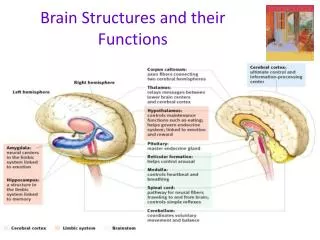
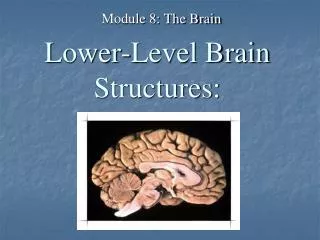
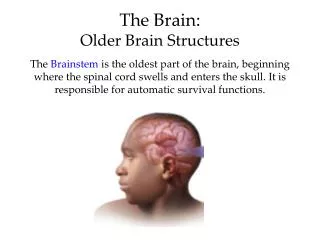
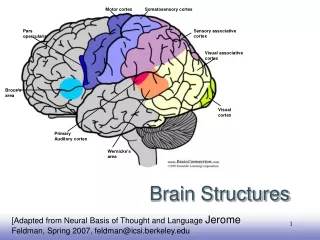
Sub cortical Brain Structures Sub cortical - underneath the cortex
The Parts of the Hindbrain • Medulla- • Regulates unconscious functions • Involuntary breathing, heart rate & blood pressure
Cerebellum • Small protrusion above medulla • Function- Coordinates the smooth movement of fine muscles and balance • Cat Love
Teen Brain-Cerebellum (You don’t understand 6min) http://www.pbs.org/wgbh/pages/frontline/video/flv/generic.html?s=frol02p392&continuous=1
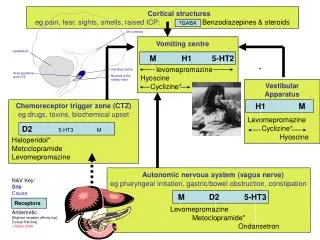
Hypothalamus • Nuclei involved in a variety of behaviors • sexual behavior • hunger, thirst • Sleep • body temperature regulation
Thalamus • Thalamus directs sensory information from the touch receptors to the cerebrum. • Exception is smell • http://www.youtube.com/watch?v=QWil81gl50I&safe=active ( 1:00 min)
Amygdala • Inputs come from all senses • Amygdala ‘reads’ emotional significance of inputs • Output influences such functions as heart rate, adrenaline release
Amygdala and Emotion Amygdala interprets facial expression Aggression in Monkeys & Cats (Anderson,2000)
Amygdala in teens Frontline Teen Brain http://www.pbs.org/wgbh/pages/frontline/video/flv/generic.html?s=frol02sfabq392&continuous=1
Hippocampus • Important in forming new memories • Case of Jeremy • You tube Olive Wearing • ( no short term)
Brain Review • Which chemicals pass across the synaptic gap and increase the potential the next neuron will fire? • A. Synaptic terminals • B. Inhibitory NTS • C. Excitatory NTs • D. Potassium & Sodium
The three main categories that organize the entire brain are the • A. old brain, new brain and cerbral cortex • B. Lower , Middle & Upper Brain • C. Hindbrain, Midbrain & Forebrain • D. Neurons, Synapse & Cerebral Cortex
Which sentence best describes Neural transmission? • A. An action potential is created in the neuron, the charge travel down the axon, and chemicals are releases the cross the synapse. • B. Neurotransmission is an electrochemical process both inside and outside the cell. • C. NTs in hindbrain are transmitted to forebrain, causing an axon potential in cortex