Understanding Conditional Statements: Hypothesis, Conclusion, and Logic
Conditional statements, expressed in the form "If... then...", consist of a hypothesis (the condition) and a conclusion (the result). For instance, in "If it rains, then it pours," "it rains" is the hypothesis, and "it pours" is the conclusion. This guide covers the structure of conditional statements, including their converse, inverse, and contrapositive forms. By learning how to negate statements and transform them into conditional form, you can enhance your understanding of logical reasoning. Examples will illustrate each concept clearly.

Understanding Conditional Statements: Hypothesis, Conclusion, and Logic
E N D
Presentation Transcript
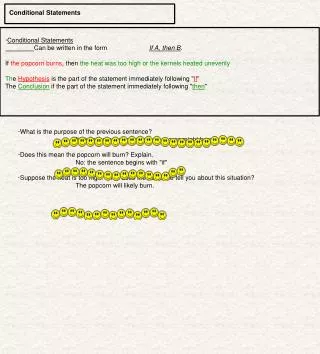
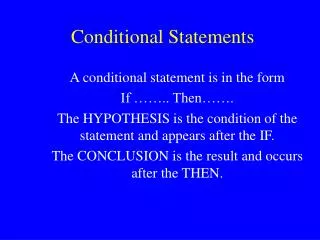
Conditional Statements A conditional statement is in the form If …….. Then……. The HYPOTHESIS is the condition of the statement and appears after the IF. The CONCLUSION is the result and occurs after the THEN.
When it rains, it pours. • Written in correct conditional form: • If it rains, then it pours.
When it rains, it pours • If it rains, then it pours. • Identify the Hypothesis and Conclusion. • Hypothesis : It rains • Conclusion: it Pours • Note: Do NOT include the IF and THEN when identifying
Regular conditional p q • Converse: q p • Switch hypothesis and conclusion • New symbol ~ means Not (in logic) • Inverse ~ p ~ q • Negate the hypothesis and conclusion • Contrapositive ~ q ~ p • Switch and negate both
If it rains, it pours. • Regular conditional:
If it rains, it pours. • Regular conditional: • If it rains, then it pours. • Converse:
If it rains, it pours • Regular conditional: • If it rains, then it pours. • Converse: • If it pours, then it rains.
If it rains, then it pours. • To negate a phrase, add “NOT”. • You may also need to modify the verb, so that it is good grammar. • Inverse: • If it doesn’t rain, then it doesn’t pour.
If it rains, then it pours. • Contrapositive: (Switch and negate)
If it rains, then it pours. • Contrapositive: (Switch and negate) • If it doesn’t pour, then it doesn’t rain.
If you are rushed, you won’t do well • Conditional: If you are rushed, then you won’t do well. • Converse: If you don’t do well, then you are rushed. • Inverse:If you aren’t rushed, then you will do well. • Contrapositive: If you do well, then you aren’t rushed.
Changing a statement to a conditional statement • Just about any statement can be changed into the “If….. then…..” form! • School closes when it snows. • If it snows, then school closes. • All new cars are expensive! • If it’s a new car, then it’s expensive. • All people have feelings. • If he’s a person, then he has feelings.