Download
1 / 9
90 likes | 207 Vues
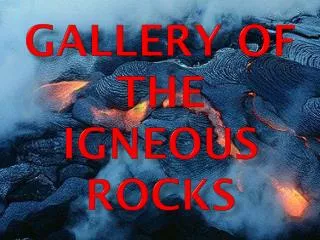
Welcome to the Gallery of Igneous Rocks! In this interactive presentation, you will find images of various igneous rocks. Carefully study each picture and determine the identity of the rock based on its description. Contest your knowledge with six unique samples, each illustrating distinct characteristics such as grain size, texture, and cooling history. Remember, the answers to this exercise are at the end of the PowerPoint—no peeking! Enhance your understanding of geology and the fascinating world of igneous rocks.

E N D
The following are pictures of igneous rocks. Please study each picture and determine the identity of the rock. The answers to the exercise are located at the end of this PowerPoint. No peeking!
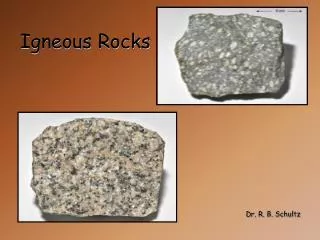
1 This rock consists of coarse-grained, interlocking crystals. It is felsic and contains numerous minerals such as feldspar, mica and quartz. This sample represents an igneous rock that cooled slowly in the earth’s crust.
2 This rock has a glassy texture and formed by rapid cooling on the earth’s surface. In fact, it cooled so quickly, it did not allow time for crystallization to occur. This rock is considered extrusive.
3 This rock has vessicular texture and will float in water. The rock cooled quickly on earth’s surface and is considered an extrusive igneous rock.
4 Vessicular texture This rock cooled rapidly on earth’s surface and contains a vessicular, fine-grained texture.
5 This felsic rock contains a fine- to-medium-grained texture and formed by fast cooling on the earth’s surface.
6 This rock consists of a fine-grained texture and represents an igneous rock that cooled by rapid cooling. This rock is also found commonly on the ocean floor.
Rock key • Rock 1 is granite. • Rock 2 is obsidian. • Rock 3 is pumice. • Rock 4 is scoria. • Rock 5 is rhyolite. • Rock 6 is basalt.