Understanding the Skeletal System: Anatomy and Physiology for High School Students
This comprehensive guide covers Chapter 7 of the Skeletal System in Anatomy and Physiology, aimed at high school students. It includes detailed notes on the structure and function of bones, types of joints, and their movements. Key topics include the anatomy of long bones, microscopic structure, bone development, and skeletal organization. Each section is designed to aid understanding of important concepts such as ossification, joint classifications, and the functional aspects of the skeletal system. Ideal for students preparing for exams or seeking to deepen their knowledge in human anatomy.


Understanding the Skeletal System: Anatomy and Physiology for High School Students
E N D
Presentation Transcript
Ch.7 Skeletal System Course: Anatomy and Physiology Glencoe High School Teacher: Mrs. Barkley
List of Note-Cards (Ch.7 Skeletal System) • #7-1 Aids to Understanding • #7-2 Intro to Bones • #7-3 Parts of a Long Bone • #7-4 Microscopic Structure • #7-5 Bone Development and Growth • #7-6 Skeletal Organization…several cards needed • #7-7 Intro to Joints • #7-8 Types of Joints • #7-9 Joint Movements
#7-1 Aids to Understanding (pg.126) • Acetubal- (vinegar cup) • Ax- (axis) • Blast- (budding) • Carp- (wrist) • -Clast (break) • Condyl- (knob) • Carac- (a crow’s beak) • Cribr- (sieve) • Crist- (crest) • Fov- (pit) • Glen- (joint socket) • Inter- (among, between) • Intra- (inside) • Meat- (passage) • Odont- (tooth) • Poie- (make, produce)
#7-2 Intro to Bones Anatomy (Structure) • Organs of skeletal system • Composed of various tissues (bone tissue, cartilage, dense connective, blood, and nervous tissus) • Provide points of attachment for muscle Physiology (Functions) • Support and protection • Body movement • Blood cell formation (hematopoises) • Storage of Inorganic Salts
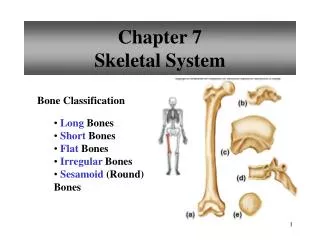
#7-3 Parts of a Long Bone • Epiphysis • Diaphysis • Periostium • Processes • Compact bone • Spongy bone • Medullary cavity Important Figures • Figure 7.1 (Major Parts of a Long Bone) • 7.2 (Cross Section of a Bone)
#7-4 Microscopic Structure • Osteocytes: bone cells • Osteocytes form cylinder shaped units called osteon. • Extracellular Matrix of Bone Tissue: collagen and inorganic salts (provide strength and resistance to crushing)
#7-5 Bone Development and Growth Bones form by replacing existing connective tissue in one of two ways… • Intramembranous Bones: form between layers of connective tissue (example: skull) • Endochondral Bones: begin as masses of cartilage that bone tissue later replaces (example: all other bones) Bones will continue to grow until ossification takes place... Injury to an epiphyseal plate before ossification takes place can cause growth to stop or be uneven…pg.129
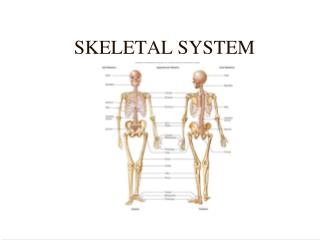
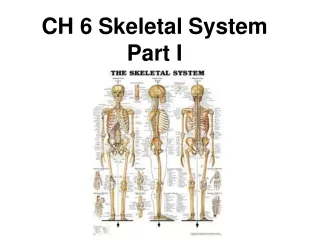
#7-6 Skeletal Organization • Axial (head, neck, and trunk) 1. Skull 2. Hyoid Bone 3. Vertebral Column 4. Thoracic Cage B. Appendicular Skeleton (appendages) 1. Pectoral Girdle 2. Upper Limbs 3. Pelvic Girdle 4. Lower Limbs
A1. Skull • Bones are interlocked along lines called sutures. • Soft Bones, called fontanels, are areas of incomplete ossification in newborns… What function does this serve? A2. Hyoid Bone • Between lower jaw and mandible • Supports tongue
A3. Vertebral Column • Vertebrae separated by discs of fibrocartilage • Protects spinal cord, which passes through vertebral foramen • Spina Bifida: occurs when the vertebrae fail to fuse correctly – making the vertebra protrude • Know Figure 7.16 A4. Thoracic Cage • Includes ribs, thoracic vertebrae, sternum, and coastal cartilage. • Know figure 7.10 (pg146)
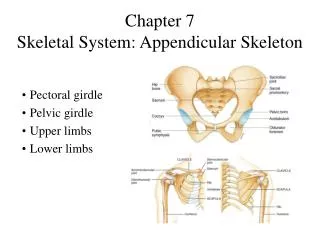
B1. Pectoral Girdle • Shoulder: composed of 2 clavicles and 2 scapula B2. Upper Limbs • Includes humerus, radius, ulna, carpals, metacarpals, and phalanges • Each finger has 3 phalanges except thumb
B3. Pelvic Girdle • Consists of 2 coxae • Pelvis: sacrum, coccyx, and pelvic girdle • Functions: supports trunk, attachement site for lower limbs, protects bladder, intestines, and reproductive organs. B4. Lower Limbs • Includes femur, tibia, fibula, tarsals, metatarsals, and phalanges • Know Figure 7.29, 7.30, and 7.31
#7-7 Intro to Joints • Functional junctions between bones • AKA: Articulations • Classified by movement (immovable, slightly movable, and freely movable) • Classified by tissue (fibrous, cartilagenous, and synovial)
#7-9 Joint Movements (pg.157-159) • Flexion • Extension • Dorsiflexion • Plantar flexion • Hyperextension • Abduction • Adduction • Rotation • Circumduction • Pronation • Supination • Eversion • Inversion • Retraction • Protraction • Elevation • Depression