Comprehensive Guide to Static Water Supply Sources for Fire Department Operations
This document provides an in-depth overview of static water supply sources essential for fire department operations. It covers crucial terms such as drafting, lift, vacuum, and atmospheric pressure, as well as the implications of drought and natural variations in water levels. Key operational challenges associated with accessing these sources, including terrain issues and equipment accessibility, are discussed. Additionally, the document emphasizes the importance of pre-incident planning for water storage tanks, ground reservoirs, and their effective use in firefighting efforts.

Comprehensive Guide to Static Water Supply Sources for Fire Department Operations
E N D
Presentation Transcript
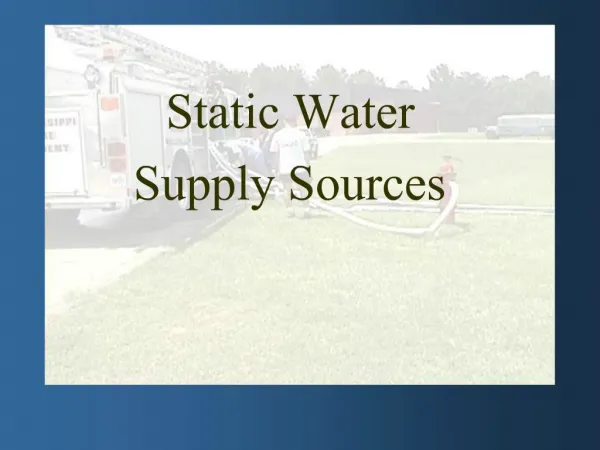
Static Water Supply Sources Sugar Land Fire Department Driver/Operator-Pumper Academy October 2000
Common Terms • Drafting • Lift • Vacuum • Atmospheric Pressure • Theoretical Lift • Maximum Lift • Dependable Lift
Static Water • Large natural static water supply sources are generally not a major adequacy issue. • Receding tides and periods of draught can sometimes limit accessibility to large natural static water supply sources • The water level of small streams and ponds may drop below the usable level during periods of draught.
Static Water • Several conditions may make the water source inaccessible to the pumper: • Bridges that are too high above the water’s surface • Bridges that will not support the weight of fire apparatus • Extremely high banks • Terrain that will not allow the apparatus close enough to reach the water with intake hoses. • Wet or soft ground approaches can trap the apparatus, effectively blocking access to the water source: • Grass and vegetation can hide soft spots
Static Water • After a vehicle stops for a period of time, settling may occur; personnel and towing apparatus will then have to be called to free the stuck vehicle • Frozen ground that allows the apparatus to be safely driven across at first may later thaw out and cause the apparatus to sink in place • Heat from the apparatus exhaust and warm water in the apparatus water tank spilling onto the ground can cause frozen ground to thaw • If the apparatus is in an effective position and pumping water when the sinking starts to occur, operations, should continue until the need for water has ended. • Soft terrain in favorable weather conditions includes land that is very marshy or that has a high sand content.
Static Water • A number of operational problems are presented by static water supply sources that contain excess silt and debris: • Clogging the strainer, resulting in reduced water intake • Seizing-up or damaging fire pumps • Clogging fog stream nozzles • All hard intake lines should have strainers attached when drafting from a natural source.
Frozen Ponds & Lakes • Barrels • Wooden plugs • Hole in Ice
Private Water Storage Tanks • Commonly found on residential, industrial, and agricultural properties • Range in size from several hundred to many thousands of gallons • May not be totally full at all times • Should be identified and capacity noted in pre-incident planning • Should not be unduly relied on by fire department personnel • Should be equipped by the owners with appropriate hardware for fire department connections
Ground Reservoirs • Most commonly found on commercial or industrial properties and at municipal water treatment • Typically contain many millions of gallons of water • Tend to be more accessible than regular ponds or lakes • May commonly be accessed by improved roads servicing one or more sides • May be outfitted with dry hydrants or water may be drawn using standard drafting operations