Understanding the Sources of Law in Canada: Constitutional, Statute, and Common Law
This overview explores the three primary sources of law in Canada: Constitutional Law, Statute Law, and Common Law. The Canadian Constitution serves as the highest authority, superseding other laws. Statute Law, created by elected officials, encompasses various acts, while Common Law evolves through judicial decisions based on precedents. Each source of law has distinct levels of authority and application. Additionally, the division of powers among federal, provincial, and local governments is outlined, illustrating how jurisdiction impacts law-making and enforcement across different levels of governance.

Understanding the Sources of Law in Canada: Constitutional, Statute, and Common Law
E N D
Presentation Transcript
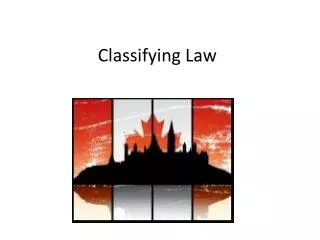
Classifying Law Sources of Canadian Law
What do you think? • Which of these situations involve law? • Explain how the law is involved in the situations you have chosen.
Sources of Law in Canada In Canada laws originate from three sources: • 1. The Canadian Constitution • (Constitutional Law) • 2. Elected Government Officials • (Statute Law) • 3. Previous Legal Decisions (Common Law)
Sources of Law in Canada • Each source of law has a different level of authority • Constitutional Law overrides Statute Law • Statute Law overrides Common Law
Common Law • CalledCommon Law because it is common to all and has a general universal application • Also called Case Law because its sources include decision made by judges in previous cases Common Law
Common Law • Constantly evolving as judges decide new cases based on previous decisions • This legal principle is known as stare decisis • Lawyers also look to favourableprecedents to argue the outcome of cases Common Law
Common Law • Rule of precedent does not always apply • A case may be identified that is sufficiently different from previous cases warranting a different decision • This is called Distinguishing a Case Common Law
Statute Law • These are laws passed by elected representatives in the form of acts • Acts are passed into law in Parliament or provincial legislatures • Many laws today are statutes – common law decisions that have been codified Statute Law
Statute Law • Statutes generally override common law • Common law only prevails when no statute law exists • When a judge interprets and applies a statute law the decision sets precedence Statute Law
Division of Powers Each level of government has the power to enact legislation in its own area of political jurisdiction Jurisdiction is the political or legal authority to pass and enforce laws, or the judicial authority to decide a case
Division of Powers Federal Government • Enacts laws within its own jurisdiction • Includes criminal law, military, and banking and currency • Everyone in Canada is subject to these laws • The federal government passes legislation in other areas as well
Division of Powers Provincial Governments • Enacts laws within its own provincial jurisdiction • Includes laws affecting health care, education, and roads and highways • Everyone in the province is subject to these laws
Division of Powers Local Governments • Create laws known as bylaws • These are regulations that deal with local issues such as snow removal and downtown parking rates
Division of Powers Aboriginal Governing Structures • As outlined in the Indian Act, each band has the authority to make bylaws that apply to its reserve land • An Aboriginal government can also be established that can make law regarding marriage, education, and adoption for example
Constitutional Law • A body of law that determines the structure of the federal government • Divides law making powers between the federal government and the provinces Constitutional Law
Constitutional Law • Limits the powers of government by setting out certain basic laws, principles, and standards that all other law must adhere to Constitutional Law
Constitutional Law • Overrides all other laws • Any law passes not in accordance with the Constitution will be struck down by the courts as unconstitutional Constitutional Law