Understanding the Nervous System: Structure, Functions, and Neural Communication
460 likes | 567 Vues
This comprehensive overview of the nervous system explores its two main components: the central nervous system (CNS) and the peripheral nervous system (PNS). Key functions such as sensory and motor actions are detailed, alongside the roles of major brain structures like the cerebrum and cerebellum. The text discusses the intricacies of neurons, synapses, and neurotransmission, illustrating the essential processes involved in feeling, thinking, moving, and maintaining homeostasis. This resource is invaluable for students and anyone interested in the complexities of the human nervous system.


Understanding the Nervous System: Structure, Functions, and Neural Communication
E N D
Presentation Transcript
Maria Buan, Melissa Jonhson, Jane Long p.5 The Nervous System – Ch. 9
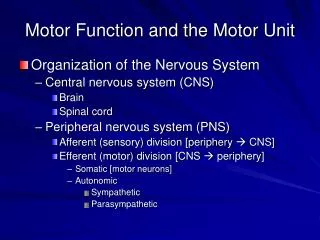
The Nervous System • Feeling, thinking, remembering, moving • Sends & receives information that stimulates muscles and glands • Brain, spinal cord, neurons, & nerves
The Nervous System SENSORY FUNCTIONS • Involuntary actions • Detects changes in the body • Creates sensations • Produces thoughts and memories MOTOR FUNCTIONS • Voluntary actions • Responds to impulse • Muscles & glands • Controls skeletal muscle system
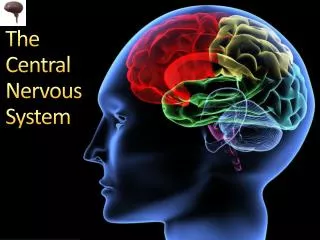
The Nervous System • Central Nervous System • Brain & spinal cord • Integrates information • “Control Center” Retrieved from http://www.umm.edu/ graphics/images/en/19588.jpg
The Nervous System • Peripheral Nervous System • Sensory & motor neurons throughout body • Receptors and effectors Retrieved from http://www.clipart.dk.co.uk/ 413/ subject/Biology/Nervous_system
Neurons • A specialized cell that transmits signals throughout the body • Cell body • Contains dendrites • Contains a nucleus Retrieved from http://scientopia.org/ blogs/scicurious/2011/05/04/science-101-the-neuron/
Neurons • Dendrites • Receives information • Axon • directs impulse away • Schwann Cells • Cells that wrap around axon • Produces myelin
Neurons Dendrites AxonTerminal Cell Body Axon Nucleus of Schwann Cell Schwann Cell Nucleus Retrieved from http://en.wikipedia.org/wiki/Neuron
Neurons Anaxonic Bipolar Unipolar Multipolar Retrived from http://iupucbio2.iupui.edu/ anatomy/images/Chapt13/FG13_10.jpg Retrieved from http://iupucbio2.iupui.edu/ anatomy/images/Chapt13/FG13_10.jpg
Synapse • Synapse: A junction between two neurons where an impulse from one neuron is sent to another • Synaptic cleft: space between two neurons
Synapse • Synaptic Transmission: Neurotransmitters cross synaptic cleft & bind to receptors of other neuron Retrived from http://scoehealthcoop.wikispaces.com/Neuron+and+Synapse
Synapse • Neurons in resting state have negative charge • As impulse move down axon, negative charges become positive, causing action potential Retrived from http://apbrwww5.apsu.edu/t hompsonj/Anatomy
Synapse • Action Potential: a rise in the number of positive ions in a neuron’s membrane that allows impulse to move down axon • Causes impulse to move across synaptic cleft to another neuron
Major Structures of the Brain • Cerebrum • Diencephalon • Brainstem • Cerebellum Retrieved from http://www.sharpbrains.com/ blog/2011/11/20/research-on-applied- neuroplasciticy-rewiring-the-brain-to-ease-pain/
Major Structures of the Brain • Cerebrum • Made up of two hemispheres • Contains 75% of all neurons • Divided into 4 lobes Retrieved from http://www.mayoclinic.com/ health/medical/IM00317
Lobes of the Brain Parietal Lobe Frontal Lobe Occipital Lobe Temporal Lobe Cerebellum Brain Stem Retrieved from http://en.wikipedia.org/wiki/File:Lobes_of_the_brain_NL.svg
Major Structures of the Brain • Four lobes of the brain: • Frontal: reasoning, planning, emotions • Parietal: orientation, recognition • Temporal: perception, memory, speech • Occipital: visual processing
Major Structures of the Brain • Functions of the Cerebrum • Provides higher brain functions • Sensory, motor, & association areas • Dominant hemispherefunctions better in verbal actions, whilenondominant specializes in nonverbal functions
Major Structures of the Brain • Diencephalon • Between the hemispheres • Thalamus and hypothalamus • Makes up the limbic system Retrieved from http://en.wikipedia.org/ wiki/File:Illu_diencephalon_.jpg
Major Structures of the Brain • Functions of the diencephalon • Receives all sensory impulses • Sensations • Maintains homestasis • Limbic system controls emotions
Major Structures of the Brain • Brainstem • Bundle of nervous tissue • Includes midbrain, pons, and medulla oblongata Retrieved from http://sccpsy101.com/home/ chapter-3/section-4/brain_stem/
Major Structures of the Brain • Functions of the Brainstem: • Midbrain: eye and head movements • Pons: sends impulses, helps regulate breathing • Medulla Oblongata: contains reflex centers
Major Structures of the Brain • Cerebellum • Located at the base of skull • Made of white matter and a thin, outer layer of gray matter Retrieved from http://neuroscience.uth .tmc.edu/s3/chapter05.html
Major Structures of the Brain • Functions of the Cerebellum • Communicates with nervous system • Specializes in positions of body parts and coordination of movements • Maintains posture
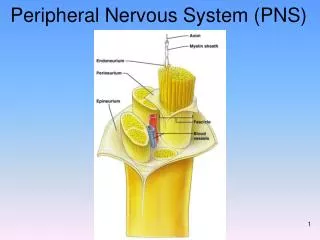
Two Nervous Systems Central • Brain & spinal cord • Processes & interprets info • Sends information to nerves Peripheral • Cranial & spinal nerves • Sends info to muscles and organs • Voluntary & involuntary
Autonomic Nervous System • Involuntary movements • Controlled by PNS • Divided into two categories • Sympathetic • Parasympathetic
Autonomic Nervous System Sympathetic • Emergency conditions • Leaves spinal cord • Secretes norepinephrine Parasympathetic • Ordinary conditions • Begins in brain and spinal cord • Secretes acetylcholine
Somatic Senses • Receptors in the skin, muscles & joints • Senses touch, temperature, pain, pressure Retrieved from http://www.medicalook.com/ human_anatomy/organs/Somatic_senses.html
Somatic Senses • Touch and pressure receptors -Senses mechanical forces that disform tissues • Free Nerve-endings • Common in epithelial tissues • Free ends extend between epithelial cells
Somatic Senses • Touch and pressure receptors cont. 2) Meissner’s corpuscles • Small, flattened connective tissue cells • Common in hairless parts of the skin • Responds to light touch
Somatic senses • Touch and pressure receptors cont. 3) Pacinian Corpuscles • Large connective tissue fiber & cells • Common in subcutaneous layer, muscle, tendons & joint ligaments • Responds to heavy pressure
Somatic Senses • Temperature senses • Warm receptors -sensitive to 77˚F(25˚C) or higher -unresponsive at & above 113˚F(stimulate pain receptors) (burning sensation)
Somatic Senses • Temperature senses cont. • Cold receptors -sensitive to 50˚F(10˚C)~68˚F(20˚C) -unresponsive below 10˚C (stimulate pain receptors) (freezing sensation)
Somatic Senses • Pain receptors • Distributed throughout the skin & internal tissues (NOT so much in the brain) • Once activated, it may send impulses to the CNS. • Thus, pain may persist.
Olfactory & Taste receptors • Chemoreceptors : chemicals dissolved in liquids stimulate them • We usually smell & taste food AT THE SAME TIME
Olfactory Nerve • Olfactory receptor cells (bipolar neurons) are stimulated by odorant molecules & send nerve impulses. • The fibers synapse with neurons in the olfactory bulbs. • Additional impulses travel along the olfactory tracts to the limbic system.
Taste buds • 10,000 taste buds associated with papillae • Taste cells (gustatory cells)=receptors • Every taste bud has 50 ~ 150 receptors
Taste Buds • 4 primary taste sensations -sweet: like sugar -sour: like lemon -salty: like salt -bitter: like caffeine
Taste Buds • Taste cell CAN respond to more than one taste sensation • Myth= one region of the tongue responds to particular sensation
Taste Buds • Sensory impulses travel to the medulla oblongata • Ascend to the thalamus and to the gustatory cortex (parietal lobe)
Taste & Smell • Odor and taste information help create the sensation of flavor • Tastants (chemicals in food) and odor molecules are similarly picked up by the cells
Taste & Smell • Taste & smell together detect flavor • Example: sick person with a stuffed nose cannot taste anything; loses appetite.
Diseases & Disorders • Huntington Disease • Disorder of the brain, involuntary movements and personality changes • Epilepsy • Disorder in CNS, causes seizures and loss of consciousness
Diseases & Disorders • Cerebral Palsy • Damaged cerebrum, causes partial paralysis/lack of muscle coordination • Aphasia • Loss of ability to use/understand words due to damage in cerebral association areas
Works Cited • "Brain Structures and Their Functions."Serendip Studio. N.p., n.d. Web. 27 Feb. 2013. <http://serendip.brynmawr.edu/bb/kinser • Cherry, Kendra. “What is a Neuron.” About.com Physcology. • "Anatomy of the Brain - Cerebellum." Biology. N.p., n.d. Web. 27 Feb. 2013. <http://biology.about.com/od/anatomy/p/c
Works Cited • "Central Nervous System."Biology. N.p., n.d. Web. 27 Feb. 2013. <http://biology.about.com/od/organsystems/ss/central-nervous-system.htm>. • "Organization of the Nervous System." The Peripheral Nervous System. N.p., n.d. Web. 27 Feb. 2013.