The Ratification Debate: Federalists vs. Antifederalists in 1787
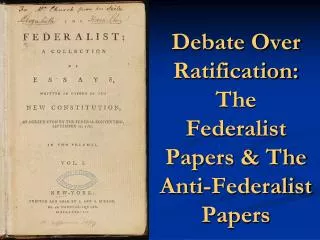
This resource delves into the critical ratification debate of the U.S. Constitution, highlighting key questions faced by delegates at the Constitutional Convention in 1787. It examines the tension between Federalists, who advocated for a strong central government, and Antifederalists, who favored states' rights and local control. Key issues explored include the limitations of democratic governance over large areas, the balance of power among branches of government, and the absence of a Bill of Rights. The resource includes analyses of The Federalist Papers and The Antifederalist Papers, providing insights into the arguments that shaped America's foundational governance.

The Ratification Debate: Federalists vs. Antifederalists in 1787
E N D
Presentation Transcript
The Ratification Debate Mr. Johnson APUSH Hopewell High School
Key Questions • Can democracy/republicanism govern a large area? • Ancient democracies were small city-states • The Roman Republic was destroyed by imperialism & Julius Caesar • Will the executive and judicial branches strangle the power of the legislative branch? • Legislature was seen as most direct expression of the people’s will • How will the rights of the states and people be safeguarded against the national government? • Constitutional convention did not include a bill of rights, unlike many of the new state constitutions • Other Questions • How can we pay off our war debt? • Where will the nation’s capital be located?
The Ratification Debate Federalists Antifederalists • Supported ratification • Strong central government • Opposed ratification • States’ rights & local control James Madison Patrick Henry
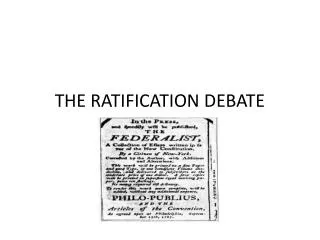
Arguing the Constitution The Federalist The Antifederalist • a.k.a. The Federalist Papers • James Madison, Alexander Hamilton, John Jay • Organized effort • Pseudonym: “Publius” • a.k.a. The Antifederalist Papers • George Clinton, Robert Yates, Samuel Bryan • Ad hoc opposition • Pseudonyms: “Brutus,” “Cato,” “Federal Farmer” Why?
Web Resources • http://teachingamericanhistory.org/ratification/