Carbohydrates
120 likes | 389 Vues
Carbohydrates are essential biomolecules classified into three main groups: monosaccharides, disaccharides, and polysaccharides. Monosaccharides, like glucose and fructose, are simple sugars and the building blocks of larger carbohydrates. Disaccharides, such as sucrose and lactose, are formed by two monosaccharides through glycosidic bonds. Polysaccharides, like starch and glycogen, consist of long chains of monosaccharides and play crucial roles in energy storage and structural support. This overview explains their structures, functions, and significance in biological systems.


Carbohydrates
E N D
Presentation Transcript
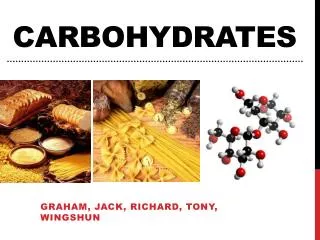
What are Carbohydrates? • Put simply…hydrocarbons. • Empirical Formula CnH2nOn • Divided into three groups • Monosaccharides • Disaccharides • Polysaccharides
Monosaccharides • Monomers…single sugar molecules. • Let’s build glucose and fructose. • How are the molecules different? • What functional groups are present?
Monomers in Use • Ribose and 2-deoxyribose are pentoses • Used in DNA and RNA • Glucose, Galactose, and Fructose are hexoses • Used in plants and animals for energy • Build into larger biological molecules like insulin.
Disaccharides • Two monosaccharides joined by a glycosidic bond. (ether) • A water molecule is generated in the process of bond formation. (condensation polymerization)
Disaccharides in Use • Sucrose • Table Sugar • Let’s build it! Join the glucose and fructose from earlier. • Lactose • Milk sugar: glucose and galactose • Lactose intolerant people lack the enzyme needed to break lactose’s glycosidic bond. • Invert Sugar • Bees use enzymes to break sucrose’s glycosidic bond to create invert sugar, which is the sweet flavor in honey.
Polysaccharides • Strings of more than 20 monosaccharides. • Starch • Major source of food calories consumed by people • Amylose (in rice!)= linear polysaccharide • Amylopectin = branched polysaccharide • Glycogen = highly branched, stored in muscles and liver until converted to fat for long term storage.
Alpha and Beta Linkages • Starch and Cellulose are made of glucose. • 2 isomer forms for linkages- alpha and beta. • Starch has alpha linkages. (cis) • Cellulose has beta linkages. (trans)
Food uses of Carbohydrates • Reducing sugars react with amino acids in the Maillard Reaction (causes browning) • Polysaccharides bind water to thicken liquids into gels. • Used to stabilize suspensions, emulsions.
Pectin • Pectin is a polysaccharide made of galacturonicacid (galactose) molecules with beta linkages. • Found in green apples, lime peel, lemon peel • When heated with sugar at low pH, branched polymerization occurs to create a thick gels.