Download
1 / 23
240 likes | 458 Vues
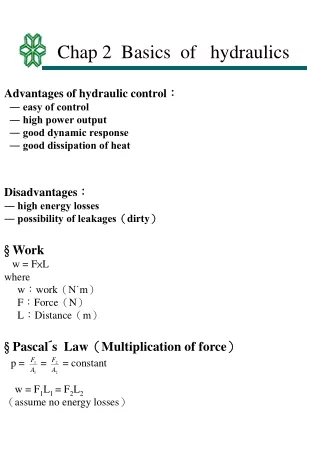
Dive into the fundamentals of hydraulics, where we explore how pressure relates to force exerted on surfaces. Discover the formula for calculating pressure (P = F/A) and understand the significance of atmospheric pressure, measured around 1 Kg/cm² or 1 Bar. Learn about Pascal's Law, which states that pressure applied to a confined fluid is transmitted undiminished in all directions, a principle discovered by French scientist Blaise Pascal in the 17th century. Grasp these essential concepts for a solid foundation in hydraulics.

E N D
1. BASICS OF HYDRAULICS
7. IN ORDER TO DETERMINE THE TOTAL FORCE EXERTED
ON A SURFACE WE NEED TO KNOW THE PRESSURE OR
FORCE PER UNIT AREA.
PRESSURE = FORCE FORCE IN ? KILOGRAMS ( Kg )
AREA AREA IN ? SQ. CM ( Cm2 )
PRESSURE IN ? KILOGRAM / SQ.CM
(Kg / Cm2 )
P = F
A
FORCE = PRESSURE x AREA
THE ATMOSPHERIC AIR EXERTS UNIFORM PRESSURE
ALL ROUND. THIS PRESSURE IS APPROX. 1 Kg / Cm2 AND
IS DENOTED AS 1 BAR ( BAROMETER )
PRESSURE
8. PASCAL’S LAW PRESSURE APPLIED ON A
CONFINED FLUID
IS TRANSMITTED
? UNDIMINISHED
? IN ALL DIRECTIONS
? ACTS WITH EQUAL FORCE ON EQUAL AREAS AND
? AT RIGHT ANGLES TO THEM FRENCH SCIENTIST
PASCAL DISCOVERED
THIS LAW IN THE
17th CENTURY.