The Nucleus
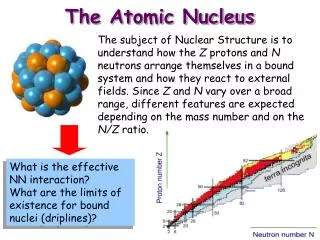
The nucleus of an atom consists of protons and neutrons, held together by nuclear force. Chemical elements are defined by their proton count, while isotopes have variations in atomic mass. For instance, Lithium has different isotopes: Lithium-7 and Lithium-6. Certain isotopes may be unstable and undergo radioactive decay, releasing energy in forms like alpha, beta, and gamma radiation. The concept of half-life indicates how long it takes for half of a radioactive sample to decay. Both fission and fusion reactions involve transformations of atomic nuclei, releasing significant energy.

The Nucleus
E N D
Presentation Transcript
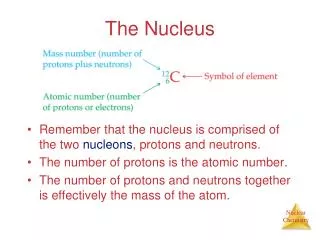
The nucleus of an atom contains two types of particles Proton Neutron
These particles can be attracted to each other by the nuclear force
A chemical element is defined by the number of protons Hydrogen Helium Lithium
But the charges pose a problem… Helium The positive charges of the protons prevent the nuclear force from keeping them together.
But the charges pose a problem… Helium The neutral charge of the neutron allows more than one proton to be present.
Isotopes are elements that have forms with different atomic masses. Lithium – 7 (%92.5 of all lithium) Lithium – 6 (%7.5 of all lithium)
The average atomic mass (periodic table) is a weighted average of all the isotopes of that element Average = (7Li atomic mass x abundance) +(6Li atomic mass x abundance) Weighted average atomic mass Average = (7 x %92.5) +(6 x %7.5) 6.9 3 6.9 Li
Some isotopes have too many or not enough neutrons and are unstable Carbon - 12 Carbon - 13 Carbon - 14
Some isotopes have too many or not enough neutrons and are unstable Carbon - 14
Some nuclei become so unstable that they release energy (radioactive)This happens in one of three ways… Alpha Decay – Nucleus releases 2p+and 2n0 Beta Decay – Nucleus releases 1e- and a n0becomes a p+ Gamma Decay – Nucleus releases a gamma ray (energy) Images from wikipedia
Radioactive Decay 6 p+ 8 n0 14C Neutron Proton 7 p+ 7 n0 14N Electron
Different types of radiation require different levels of protection Sheet of paper Sheet of aluminum Thick layer of lead Images from wikipedia
Decay and Half-Life • Nuclei decay in a very predictable way. • Half-Life: The time it takes for one half of the sample to decay. • If you had 100 atoms of Carbon-14, it would take 5730 years for 50 of them to become Nitrogen-14. • If you had 1,000,000 atoms of C-14, it would take 5730 years for 500,000 of them to become N-14.
Decay and Half-Life 25 atoms of 14C 50 atoms of 14C 100 atoms of 14C 12-13 atoms of 14C C C C C C C C C C C C C C C C C C C C C C C C C C C C C C C C C C C C C C C C C C C C C C C C C C C C C C C C C C C C C C C C C C C C C C C C C C C C C C C C C C C C C C C C C C C C C C C N N N N N N N N N N N N N N N N N N N N C C C N N N N N N N N N N N N N N N N N N N N N N C N N N N N N N N N N N N N N N N N N N N C C N N N N N N N N N N N N N N N N N N N N N N N N N 3(5730 years) = 17910 years 2(5730 years) = 11460 years 5730 years
A fission reaction is where a very heavy nucleus (U, Pu) is split to release two small nuclei, neutrons, and a great deal of energy Ba-141 Kr-92 U-235 neutrons
Fusion reactions involve two smaller nuclei joining to become a bigger nucleus