THE SHOULDER COMPLEX
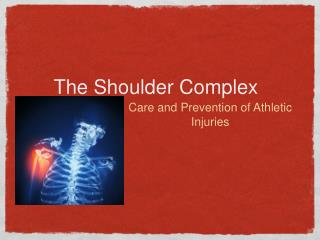
THE SHOULDER COMPLEX. SHOULDER COMPLEX. Anatomy of shoulder complex allows for a great degree of mobility. Because of the great degree of mobility, stability is sacrificed. Overuse injuries are common. BONES OF SHOULDER COMPLEX. CLAVICLE SCAPULA HUMERUS. SHOULDER COMPLEX ARTICULATIONS.

THE SHOULDER COMPLEX
E N D
Presentation Transcript
SHOULDER COMPLEX • Anatomy of shoulder complex allows for a great degree of mobility. • Because of the great degree of mobility, stability is sacrificed. • Overuse injuries are common
BONES OF SHOULDER COMPLEX • CLAVICLE • SCAPULA • HUMERUS
SHOULDER COMPLEX ARTICULATIONS • Sternoclavicular • Acromioclavicula • Glenohumeral • Scapulothoracic
Glenohumeral Joint Movements Flexion Extension Abduction Adduction External Rotation Internal Rotation Circumduction
Movements Cont. • Horizontal Abduction • Horizontal Adduction • Elevation • Depression • Protraction • Retraction
Glenohumeral Joint Muscles • Originates in axial skeleton and inserts on the humerus • Latissmus dorsi- internal rotation, extension. • Pectoralis major- horizontal adduction, flexion.
Glenohumeral Joint Muscles • Originates on Scapula and attach to Humerus • Anterior Deltoid • Abduction • Flexion • Lateral Deltoid • Abduction • Posterior Deltoid • Abduction • Extension
Glenohumeral Joint Muscles • Teres Major • Internal Rotation • Extension • Coracobrachialis • Flexion • Horizontal Adduction
Glenohumeral Joint Muscles • Rotator Cuff • Supraspinatus • Abduction • External Rotation • Infraspinatus • External Rotation • Extension • Teres minor • External Rotation • Extension • Subscapularis • Flexion • Internal Rotation
Glenohumeral Joint Muscles • Originates on Axial Skeleton Insertion point on Scapula • Levator Scapula • Elevation • Trapezius • Part 1: Elevation • Part 2: Elevation, Adduction of Scapula • Part 3: Adduction of Scapula • Part 4: Depression, Adduction of Scapula
Glenohumeral Joint Muscles • Rhomboids • Adduction of Scapula • Elevation • Serratus anterior • Abduction of Scapula
Acromioclavicular Ligaments • Coracoacromial ligament • Acromioclavicular ligament • Coracoclavicular ligament
Prevention of Shoulder Injuries • Proper physical conditioning • Strengthen shoulder muscles through the full Range of Motion. • Proper warm-up and Stretch • Falling properly (ie shoulder roll) • Properly fitted protective equipment • Proper technique
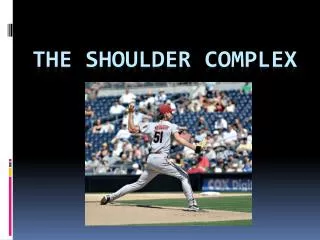
Correct Throwing Technique • Wind-up Phase • Cocking Phase • Acceleration • Deceleration • Follow Through
Wind-up Phase • First movement until ball leaves gloved hand • Lead leg strides forward • Both shoulders abduct, externally rotate, and horizontally abduct.
Cocking Phase • Hands separate until maximal external rotation of the humerus • Foot comes in contact with ground
Acceleration • Maximum external rotation until ball is released • Humerus abducts, horizontally abducts and internally rotates. • Scapula elevates, abducts, and upward rotates.
Deceleration • Ball release until maximal shoulder internal rotation. • External rotators act as decelerators by eccentrically contracting
Follow Through • Last phase of throwing • Maximum internal rotation until the end of the motion. • Balanced position • Important phase to avoid throwing injuries.
Assessing the Shoulder • One of the most difficult regions of the body to evaluate.
HISTORY • What happened to cause this pain? • Have you ever had this problem? • What is the duration and intensity of pain? • Where is pain located? • Is there crepitus during movement or numbness or distortion in temperature such as a cold or warm feeling?
HISTORY • Is there a feeling of weakness or a sense of fatigue? • What shoulder movements or positions seem to aggravate or relieve the pain? • If therapy has been given before, what, if anything offered pain relief?
ANTERIOR OBSERVATION • Are both shoulder tips even with one another? • Is one shoulder held higher because of muscle spasm or guarding? • Is the lateral end of the clavicle prominent? • Is one lateral acromion process more prominent that the other?
ANTERIOR OBSERVATION • Does the clavicular shaft appear deformed? • Is there loss of the normal lateral deltoid muscle contour? • Is there an indentation in the upper biceps region?
LATERAL OBSERVATON • Is there thoracic kyphosis or are the shoulders slumped forward? • Is there forward or backward arm hang?
POSTERIOR OBSERVATION • Is there asymmetry such as a low shoulder, uneven scapulae, or winging of one scapular wing and not the other? • Is the scapula protracted because of constricted pectoral muscles? • Is there a distracted or winged scapula on one or both sides?
PALPATION • Done anteriorly and posteriorly • Both shoulder are palpated at same time for pain sites and deformities. • Detects point tenderness, abnormal swelling or lumps, muscle spasm or guarding, and trigger points.
SPECIAL TESTS • Active and passive range of motion should be noted and compared to opposite side. • Strength of the of the shoulder musculature should be assessed by resisted manual muscle testing.
APPREHENSION TEST (crank test) • With arm abducted 90 degrees. • Shoulder is slowly and gently externally rotated as far as the athlete will allow. • Athlete with anterior glenohumeral instability will show apprehension before end point can be reached.
Test for Shoulder Impingement • Forced flexion of the humerus in the overhead position may cause impingement of soft tissue structures. • Horizontal adduction with forced internal rotation of the humerus.
Test for Supraspinatus Muscle Weakness • Empty Can Test: • Bring both arms in to 90 degrees of forward flexion • 30 degrees of horizontal abduction • Arms are internally rotated as far as possible, thumbs pointing down. • Downward pressure applied. • Arms should be the same strength.