Download
1 / 8
80 likes | 211 Vues
This week’s focus delves into the fundamental characteristics that define various organisms, including their classification into prokaryotic or eukaryotic, unicellular or multicellular, autotrophic or heterotrophic, and modes of reproduction. Students will engage in activities and discussions aimed at comparing and contrasting these classifications and understanding the significance of each characteristic. The importance of the Eukarya, Archaea, and Bacteria domains will also be explored, alongside the distinctions between asexual and sexual reproduction.

E N D
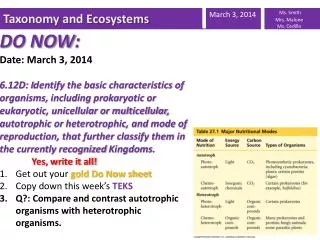
Ms. Smith Mrs. Malone Ms. Cedillo Taxonomy and Ecosystems March 3, 2014 • DO NOW: • Date: March 3, 2014 • 6.12D: Identify the basic characteristics of organisms, including prokaryotic or eukaryotic, unicellular or multicellular, autotrophic or heterotrophic, and mode of reproduction, that further classify them in the currently recognized Kingdoms. • Yes, write it all! • Get out your gold Do Now sheet • Copy down this week’s TEKS • Q?: Compare and contrast autotrophic organisms with heterotrophic organisms.
Ms. Smith Mrs. Malone Ms. Cedillo Taxonomy and Ecosystems March 3, 2014 • DO NOW: • Date: March 3, 2014 • Grade Level • 6.12D: Identify the basic characteristics of organisms, including prokaryotic or eukaryotic, unicellular or multicellular, autotrophic or heterotrophic, and mode of reproduction, that further classify them in the currently recognized Kingdoms. • Yes, write it all! • Get out your gold Do Now sheet • Copy down this week’s TEKS • Q?: How are autotrophs and heterotrophs different?
Ms. Smith Mrs. Malone Ms. Cedillo Taxonomy and Ecosystems March 4, 2014 • DO NOW: • Date: March 4, 2014 • 6.12D: Identify the basic characteristics of organisms, including prokaryotic or eukaryotic, unicellular or multicellular, autotrophic or heterotrophic, and mode of reproduction, that further classify them in the currently recognized Kingdoms. • Yes, write it all! • Get out your gold Do Now sheet • Did you write this week’s TEKS? • Q?: Compare and contrast prokaryotes and eukaryotes.
Ms. Smith Mrs. Malone Ms. Cedillo Taxonomy and Ecosystems March 4, 2014 • DO NOW: • Date: March 4, 2014 • Grade Level • 6.12D: Identify the basic characteristics of organisms, including prokaryotic or eukaryotic, unicellular or multicellular, autotrophic or heterotrophic, and mode of reproduction, that further classify them in the currently recognized Kingdoms. • Yes, write it all! • Get out your gold Do Now sheet • Did you write this week’s TEKS? • Q?: How are prokaryotes and eukaryotes different?
Ms. Smith Mrs. Malone Ms. Cedillo Taxonomy and Ecosystems March 5-6, 2014 • DO NOW: • Date: March 5-6, 2014 • 6.12D: Identify the basic characteristics of organisms, including prokaryotic or eukaryotic, unicellular or multicellular, autotrophic or heterotrophic, and mode of reproduction, that further classify them in the currently recognized Kingdoms. • Yes, write it all! • Get out your gold Do Now sheet • Did you write this week’s TEKS? • Q?: How can you determine if an organism belongs in the Eukarya, Archaea, or Bacteria domain?
Ms. Smith Mrs. Malone Ms. Cedillo Taxonomy and Ecosystems March 5-6, 2014 • DO NOW: • Date: March 5-6, 2014 • Grade Level • 6.12D: Identify the basic characteristics of organisms, including prokaryotic or eukaryotic, unicellular or multicellular, autotrophic or heterotrophic, and mode of reproduction, that further classify them in the currently recognized Kingdoms. • Yes, write it all! • Get out your gold Do Now sheet • Did you write this week’s TEKS? • Q?: Why would you classify a prokaryote in the Archaea domain? (In other words: What is special about Archaea prokaryotes that would kill Bacteria prokaryotes?)
Ms. Smith Mrs. Malone Ms. Cedillo Taxonomy and Ecosystems March 7, 2014 • DO NOW: • Date: March 7, 2014 • 6.12D: Identify the basic characteristics of organisms, including prokaryotic or eukaryotic, unicellular or multicellular, autotrophic or heterotrophic, and mode of reproduction, that further classify them in the currently recognized Kingdoms. • Yes, write it all! • Get out your gold Do Now sheet • Did you write this week’s TEKS? • Q?: Which mode of reproduction creates more variety in the offspring: asexual or sexual reproduction? Explain!
Ms. Smith Mrs. Malone Ms. Cedillo Taxonomy and Ecosystems March 7, 2014 • DO NOW: • Date: March 7, 2014 • Grade Level • 6.12D: Identify the basic characteristics of organisms, including prokaryotic or eukaryotic, unicellular or multicellular, autotrophic or heterotrophic, and mode of reproduction, that further classify them in the currently recognized Kingdoms. • Yes, write it all! • Get out your gold Do Now sheet • Did you write this week’s TEKS? • Q?: A bacteria reproduces by itself and the offspring are exactly identical to the parent cell. Is this sexual or asexual reproduction?