Understanding Molarity: Calculation and Examples for Solutions in Chemistry
This guide provides a comprehensive overview of molarity, the measurement of solute concentration in a solution. It explains how to calculate molarity using examples such as dissolving sodium hydroxide and HCl in water. Additionally, it covers related calculations, including determining the number of moles of ions in solutions, and analyzing the volume of blood that contains specific concentrations of NaCl. The concept of dilution is also explored, illustrating how to achieve desired molarity by adjusting solution volumes.

Understanding Molarity: Calculation and Examples for Solutions in Chemistry
E N D
Presentation Transcript
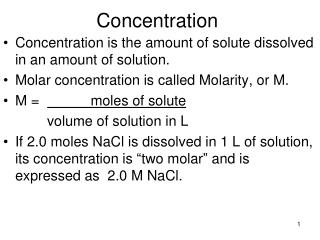
Molarity • Moles of solute per liter of solution
Ex. 1 • What is the molarity of a solution that was prepared by dissolving 11.5g of solid sodium hydroxide in 1.50L of water?
Ex. 2 • Calculate the molarity of a solution prepared by dissolving 1.56g of gaseous HCl in enough water to make 26.8 mL of solution.
Examples • Calculate the number of moles of chloride ions in 1.75L of .0010 M zinc chloride. • Typical blood serum is about 0.14M NaCl. What volume of blood contains 1.0mg of NaCl? • To analyze the alcohol content of a certain wine, a chemist needs 1.00 L of an aqueous potassium dichromate solution. How much solid must be weighed out to make this solution?
Dilution • When water is added to a concentrated solution in order to achieve the desired molarity (molarity)(volume) = (molarity)(volume)
Ex. • What volume of 16M sulfuric acid must be used to prepare 1.5L of a .10 M solution?