

SlideServe
Menu
Préférences
© SlideServe · v2026

Concentration

kyran avatar
8 diapositives · 884 Views · Aug 26, 2014

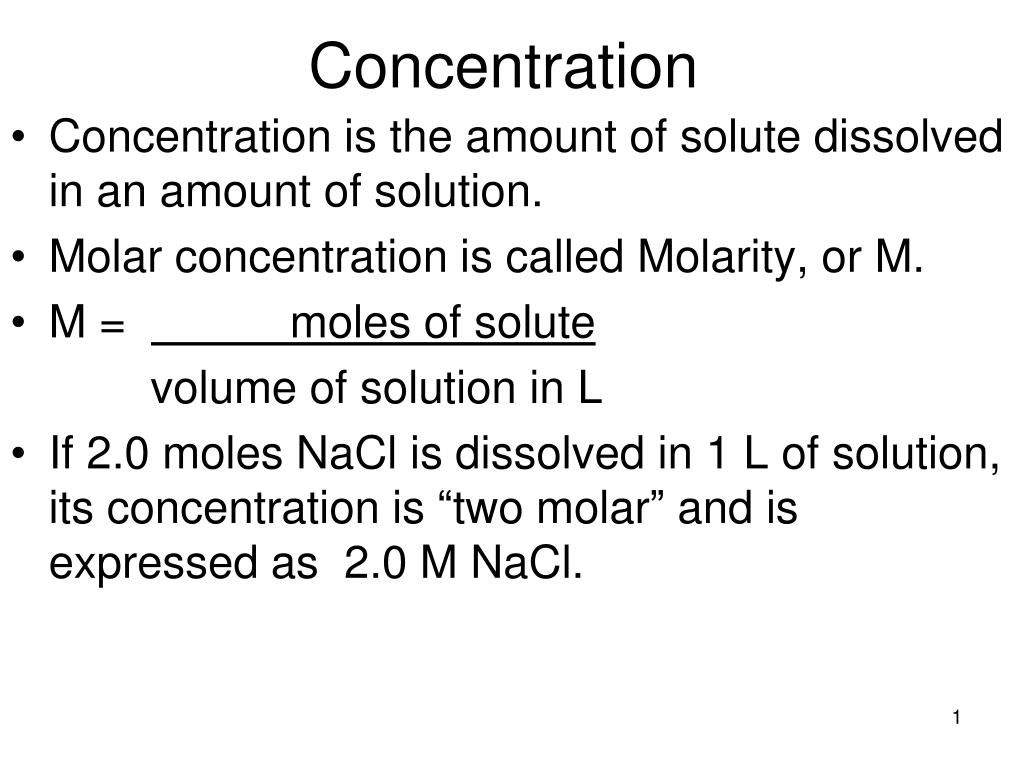
Concentration. Concentration is the amount of solute dissolved in an amount of solution. Molar concentration is called Molarity, or M. M = moles of solute volume of solution in L
Concentration - slide 1
01 / 8Concentration
1 / 17

Télécharger la présentation

Concentration
Une image / un lien ci-dessous est fourni (tel quel) pour télécharger la présentation

Politique de téléchargement : le contenu du site vous est fourni TEL QUEL pour votre information et votre usage personnel ; il ne peut être vendu, concédé sous licence ni partagé sur d’autres sites sans l’accord de son auteur.Le contenu vous est fourni TEL QUEL, pour votre information et votre usage personnel uniquement. Téléchargez la présentation en cliquant sur ce lien. Lors du téléchargement, si vous ne parvenez pas à télécharger une présentation, l’éditeur a peut-être supprimé le fichier de son serveur.Pendant le téléchargement, si vous ne parvenez pas à obtenir une présentation, le fichier a peut-être été supprimé par l’éditeur.

F I N

Plus de contenu associé

Transcription de la présentation
  1. Concentration • Concentration is the amount of solute dissolved in an amount of solution. • Molar concentration is called Molarity, or M. • M = moles of solute volume of solution in L • If 2.0 moles NaCl is dissolved in 1 L of solution, its concentration is “two molar” and is expressed as 2.0 M NaCl.

  2. Steps to make a 1 M solutionExample: 1 M NaOH solution • Calculate the mass needed. 1 mol NaOH 40.01 g NaOH = 40.01 g NaOH 1 mol NaOH • Measure this amount of NaOH into a beaker, then add about 200 mL solvent to dissolve it. • Pour the solution into a 1.0 L volumetric flask. • Rinse the beaker with more solvent and add to the flask. • Add solvent until the solution meets the line indicating 1.0 L. • Stopper the flask and swirl, mix thoroughly.

  3. Find Molarity Example 1: What is the molarity of a solution made with 3.66 moles solute in 0.500 L? M = mol = 3.66 mol = L .500 L 7.32 M

  4. Find Molarity, given mL Ex. 2: What is the molarity of a solution made with1.50 mole solute in 250 mL? In order to find M, need volume in L: 250 mL | 1 L____ = _____L | 1000 mL (or move decimal to left 3 places) M = mol = 1.50 mol = ______ M _____ L .250 L 6.0 M

  5. Find Molarity, given grams Ex. 3: What is the molarity of a solution made with 55.0 g KCl in 0.250 L? In order to find M, need moles first: 55g KCl | 1 mol KCl = _____mol KCl | 74.5 g KCl M = mol = . mol = ______ M KCl L .500 L .738 mol 1.48 M

  6. Find Moles Ex. 4: How many moles of KCl are in a 100 mL sample of 0.67 M solution? In order to find moles, rearrange the molarity equation: M = mol →mol = (M)(L) = (0.67mol)(0.100L) = L L .067 mol

  7. Find Grams Ex. 4: How many grams of KCl are in a 100. mL sample of 0.670 M solution? Find moles, then convert to grams using periodic table masses. In order to find moles, rearrange the molarity equation: M = mol →mol = (M)(L) = (0.67mol)(0.100L) = L L 0.67 mol | 74.5 g KCl = | 1mol KCl .067 mol 4.99 g

  8. Find Volume To produce 23.4 g of K2CrO4 from 6.0 M K2CrO4, what volume of the solution is needed? Given: 23.4 g K2CrO4 needed concentration of solution = 6 moles K2CrO4 per 1 L Want: volume of K2CrO4 in solution 23.4 g K2CrO4 1mol K2CrO4 = 194.2g K2CrO4 0.120 mol K2CrO4 1 L = 6 mol K2CrO4 0.120 mol K2CrO4 0.020 L K2CrO4 soln