Impact of Oxygen Binding on Hemoglobin Dynamics at the C-Terminus of Beta Subunit
50 likes | 185 Vues
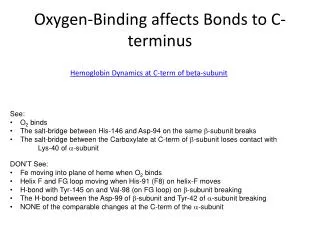
This study explores how oxygen (O2) binding affects the dynamics of hemoglobin, specifically at the C-terminus of the beta subunit. Notably, the salt bridges involving His-146 and Asp-94 break under O2 binding, altering interactions with Lys-40 on the alpha subunit. Although certain movements and bonding changes are expected during O2 binding, such as the Fe atom's position relative to the heme and the breaking of key hydrogen bonds, comparable changes in the alpha subunit's C-terminus are not observed. This research sheds light on hemoglobin's functional dynamics and the role of protein folding and unfolding.


Impact of Oxygen Binding on Hemoglobin Dynamics at the C-Terminus of Beta Subunit
E N D
Presentation Transcript
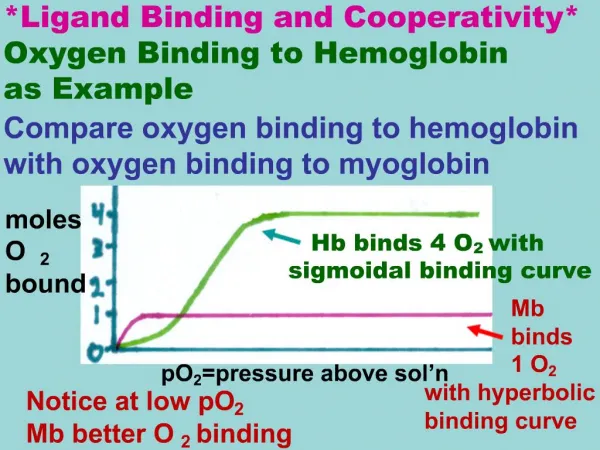
Oxygen-Binding affects Bonds to C-terminus Hemoglobin Dynamics at C-term of beta-subunit • See: • O2 binds • The salt-bridge between His-146 and Asp-94 on the same b-subunit breaks • The salt-bridge between the Carboxylate at C-term of b-subunit loses contact with Lys-40 of a-subunit • DON’T See: • Fe moving into plane of heme when O2binds • Helix F and FG loop moving when His-91 (F8) on helix-F moves • H-bond with Tyr-145 on and Val-98 (on FG loop) onb-subunit breaking • The H-bond between the Asp-99 of b-subunit and Tyr-42 of a-subunit breaking • NONE of the comparable changes at the C-term of the a-subunit
Unfolding = Denaturation • Disrupt forces that hold protein in tertiary structure