Dynamic Network Allocation Enhances Scientific Experiments on Lambda-Grids
Explore the benefits of dynamic network allocation in e-Science with "Mouse.BIRN" example, enabling new scientific experiments that are not feasible with static allocation methods. Learn from observations by Tal Lavian on enhancing research processes.

Dynamic Network Allocation Enhances Scientific Experiments on Lambda-Grids
E N D
Presentation Transcript
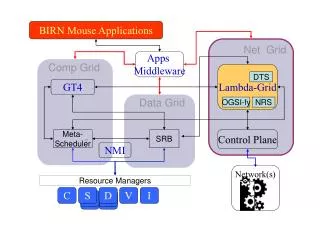
BIRN Mouse Applications Net Grid Apps Middleware Comp Grid Lambda-Grid DTS GT4 Data Grid OGSI-fy NRS Meta- Scheduler SRB Control Plane Network(s) NMI Resource Managers C S D V I S D S S
e-Science example “Mouse BIRN” • Other Observations: • Not Feasible To Port Computation to Data • Delays Preclude Interactive Research: Copy, Then Analyze • Uncertain Transport Times Force A Sequential Process – Schedule Processing After Data Has Arrived • No cooperation/interaction among Storage, Computation & Network Middlewares • Dynamic network allocation as part of Grid Workflow, allows for new scientific experiments that are not possible with today’s static allocation Source: Tal Lavian (UCB, Nortel Labs)