Ultra-Low Power Data Storage Solutions for Sensor Networks: A Comparative Study
This research explores various flash memory storage options for sensor networks, including NOR, NAND, and multimedia cards, focusing on their energy efficiency. With a comparative analysis of their power consumption and operational costs, the study reveals that parallel NAND flash offers the best performance, providing nearly infinite storage capacity with much lower energy costs. By demonstrating higher efficiency in data archival and in-network query processing, the research highlights the implications of ultra-low power storage on sensor network design, particularly in applications such as camera and acoustic sensing.

Ultra-Low Power Data Storage Solutions for Sensor Networks: A Comparative Study
E N D
Presentation Transcript
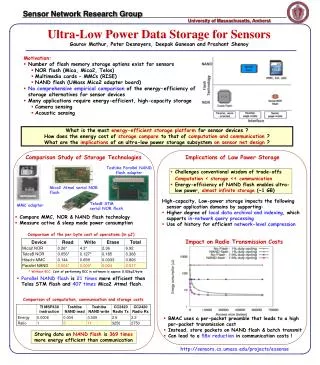
Sensor Network Research Group University of Massachusetts, Amherst Ultra-Low Power Data Storage for Sensors Gaurav Mathur, Peter Desnoyers, Deepak Ganesan and Prashant Shenoy • Motivation: • Number of flash memory storage options exist for sensors • NOR flash (Mica, Mica2, Telos) • Multimedia cards – MMCs (RISE) • NAND flash (UMass Mica2 adapter board) • No comprehensive empirical comparison of the energy-efficiency of storage alternatives for sensor devices • Many applications require energy-efficient, high-capacity storage • Camera sensing • Acoustic sensing What is the mostenergy-efficient storage platformfor sensor devices ? How does the energy cost ofstorage compareto that ofcomputation and communication? What are theimplications of an ultra-low power storage subsystemon sensor net design? Comparison Study of Storage Technologies Implications of Low Power Storage Toshiba Parallel NAND flash adapter • Challenges conventional wisdom of trade-offs Computation < storage << communication • Energy-efficiency of NAND flash enables ultra-low power, almost infinite storage (~1 GB) Mica2 Atmel serial NOR flash High-capacity, Low-power storage impacts the following sensor application domains by supporting: • Higher degree of local data archival and indexing, which supports in-network query processing • Use of history for efficient network-level compression TelosB STM serial NOR flash MMC adapter • Compare MMC, NOR & NAND flash technology • Measure active & sleep mode power consumption Comparison of the per byte cost of operations (in μJ) Impact on Radio Transmission Costs * Without ECC. Cost of performing ECC in software is approx 0.026μJ/byte • Parallel NAND flash is 21 times more efficient than Telos STM flash and 407 times Mica2 Atmel flash. Comparison of computation, communication and storage costs • BMAC uses a per-packet preamble that leads to a high per-packet transmission cost • Instead, store packets on NAND flash & batch transmit • Can lead to a 58x reduction in communication costs ! Storing data on NAND flashis 369 times more energy efficient than communication http://sensors.cs.umass.edu/projects/essense