Trends and Challenges in Distributed Generation in Texas: Landfill, Wind, and Solar Resources
This analysis explores the current state of distributed generation (DG) in Texas, focusing on renewable energy sources such as wind, solar, and landfill gas. Since 1986, Texas has implemented net metering laws for renewables, yet the interconnection costs with CPS Energy remain high. Various DG projects have surfaced, including landfill and solar initiatives, revealing significant payback periods and maintenance challenges, particularly for micro-turbines and fuel cells. We examine the evolving landscape, operational processes, and the future of renewable DG technologies in the region.

Trends and Challenges in Distributed Generation in Texas: Landfill, Wind, and Solar Resources
E N D
Presentation Transcript
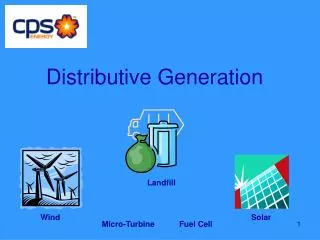
Distributive Generation Landfill Wind Solar Micro-Turbine Fuel Cell
Major Issues and Trends • Texas has net metering law in place since 1986 for renewables only. • On Feb 4 1999, the Public Utility Commission of Texas adopted interconnection guidelines for distributed generation and requested that staff continue its investigation of distributed resources • The costs of interconnection with CPS Energy can get expensive. System upgrades are borne by the Customer, such as service line and/or meter facilities, conductor, communications, SCADA equipment, etc. required for the interconnection. • High Voltage readings at interconnection point • Micro turbine and Fuel Cell projects have shown to be too expensive to maintain • Solar – estimated payback is 20yrs Trends • Landfills receive over 5,100 Tons of garbage daily, with decomposition in about 5-6 yrs. Covel location expected to double its generating capacity. • Wind continues to be a dominant source of renewable DG, with another 130 MW coming on-line.
Volume of Requests Requests have been minimal • 3 Landfill Projects • Tessman Garden (4.8MW) • Covel Garden (9.6MW) • Nelson Garden (3.0MW) • 1 Fuel Cell • 1 Micro turbine (80kW) • 4 Solar (private customer, Institute of Texan Culture & CPS Energy – 40kW) • Wind (260MW)
Overall Process • The electrical generation equipment must be powered by renewable energy sources: • The sun (directly or indirectly) • Wind • Geothermal sources • Biomass and/or biomass-based waste products (including landfill gas) • Customers interested in DG must fill out an application. • CPS Energy issues a study fee to applicant • CPS Energy determines if circuit upgrades are needed (if so, upgrade costs are added to Agreement) • Application is approved and agreement is submitted to Applicant • After Agreement is signed by applicant, upgrades to distribution circuit are performed, including communications, SCADA, protective relaying, & metering • Once Commissioning Tests are conducted, DG is approved for operation • CPS Energy will ensure that the required DG safety devices are operating properly. These devices provide safety to our personnel who are performing maintenance on distribution facilities. All customer equipment -- up to the service point -- will be inspected by the City of San Antonio to ensure compliance with City of San Antonio codes.
Unusual Installations • San Antonio Water Systems (SAWS) proposing a DG project at a sewer treatment plant. Fuel source – Methane Gas • Fuel Refinery – proposing a 10MW DG project. Fuel source - a product of hydrogen that would be combined with LP gas • Engine Testing Laboratory – various size engines (lawnmower to diesel trucks) that when attached to a generator, the load generated by the engine is dumped onto the distribution grid
Landfill Gas Projects Covel Garden Landfill 6 – 1.3 MW Units 9.6 MW Total Nelson Garden Landfill 2 – 1.5 MW Units 3.0 MW Total
What’s Next? Landfill Wind Solar Micro-Turbine Fuel Cell