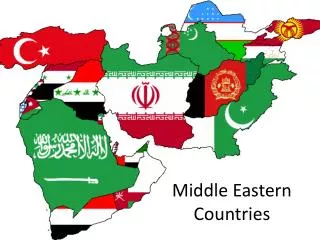
Middle Eastern Countries
The Middle Eastern landscape is witnessing significant political upheaval, with Tunisia's secular opposition calling for government ouster following two assassinations. In Algeria, former Guantánamo detainees face judicial control upon their return. Egypt grapples with a violent crackdown, reporting over 1,000 deaths amid military tensions. Libya marks the anniversary of Gaddafi's death as civil conflict looms. Saudi Arabia explores potential shifts in cinema policy, while Jordan faces protests over fuel price hikes. Yemen endures clashes tied to loyalty divisions, and Syria confronts accusations of using chemical weapons.

Middle Eastern Countries
E N D
Presentation Transcript
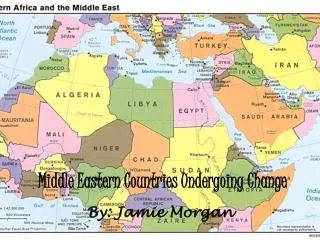
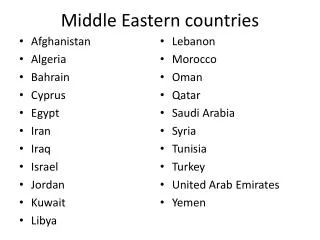
Middle Eastern Countries Tunisia, Algeria, Egypt, Libya, Saudi Arabia, Jordan, Yemen, and Syria
Tunisia The secular opposition, angered by two assassinations in its ranks and emboldened by the army-backed toppling of Egypt's Islamist president, is trying to topple Tunisia's government led by the moderate Islamist party Ennahda. • “Tens of thousands of Tunisians crowded the streets of downtown Tunis on Tuesday to demand the transitional government's ouster, in the largest opposition protest since the country's political crisis began two weeks ago. “
Algeria • A judge has placed two detainees recently released from the American prison at Guantánamo Bay under “judicial control,” which is a form of supervised parole. The men, Nabil Hadjarab and MutiaSadiq Ahmad Sayyab, were returned to Algeria last week and detained pending interrogation by a prosecutor, which took place on Thursday, the state news agency reported. Their treatment follows the pattern for other Algerians released from Guantánamo Bay. Most of the other 13 detainees returned to Algeria so far have been released by the Algerian authorities. Mr. Hadjarab’s lawyer, Joseph Breham, said he was working to get him resettled in France.
Egypt • With an estimated death toll of over 1,000 people since Wednesday, the fever in Egypt appeared to break over the weekend. Then came reports, confirmed by the Egyptian government on Sunday, that at least 36 Islamists were killed while in military custody. The violent crackdown has left Mr. Obama in a no-win position: risk a partnership that has been the bedrock of Middle East peace for 35 years, or stand by while longtime allies try to hold on to power by mowing down opponents
Libya Libya marks the second anniversary of the death of Muammar Gaddafi with the country on the brink of a new civil war and fighting raging in the eastern city of Benghazi, birthplace of its Arab spring revolution.
Saudi Arabia The chief of Saudi Arabia's powerful religious police has said some movies may be acceptable in the kingdom, despite a three-decade ban on cinemas, local press reported on Sunday. Women-only city expected to create 5,000 jobs as well as women-run firms and production lines. Saudi government hopes endeavor will address gender employment gap.
Jordan "Freedom is from God, in spite of you, Abdullah," they shouted. "Revolution, revolution, it is a popular revolution," chanted about 2,000 in an impromptu demonstration Demonstrations and calls for general strikes hit key U.S. ally Jordan after the country’s prime minister added to the country’s economic problems by announcing price hikes for gas and other fuel. Abdullah Ensour's announcement on state television Tuesday cited a need to offset $5 billion in state losses by increasing fuel costs.
Yemen Clashes between forces loyal to Yemen’s president and those loyal to rebel tribesman sent residents fleeing for safety outside of the city. Yemeni soldiers who joined sides with anti-regime protesters wave their rifles and chant slogans during a demonstration calling for the ouster of President Ali Abdullah Saleh in Sanaa
Syria U.S. President Barack Obama has said there's no doubt that Syria launched chemical weapons attacks against its own people. Syrian President Bashar al-Assad's regime has blamed the August 21 attack on rebels.