Understanding Partition Coefficient and Solvent Extraction in Chromatography
This guide explores the concept of partition coefficients and their role in separating immiscible liquids, especially in solvent extraction processes. It delves into how solutes distribute themselves between two phases, typically water and an organic solvent like ether or chloroform. Through examples and calculations, it demonstrates how to determine the amount of solute extracted based on partition coefficients. The document also introduces various chromatography methods, emphasizing the significance of stationary and mobile phases and encouraging collaborative note-taking for further learning.

Understanding Partition Coefficient and Solvent Extraction in Chromatography
E N D
Presentation Transcript
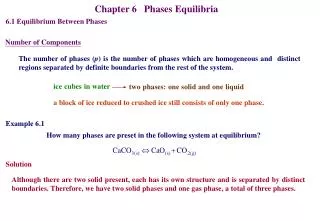
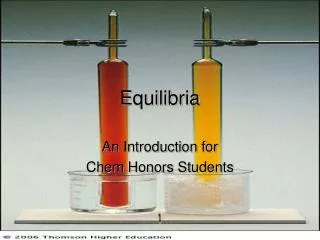
Equilibria between different phases Advanced Higher Unit 2b(ii)
Separating Funnel • Separates immiscible liquids with different densities • Usually water, plus an organic solvent (ether, chloroform)
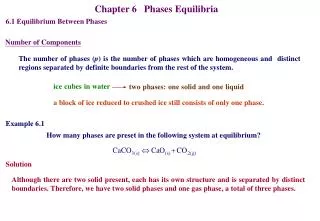
[solute](organic) K = [solute](aq) Partition Coefficient • When a solute is added to two such immiscible liquids, some will dissolve in each layer • The distribution will not be even • Ratio of distributed called PARTITION COEFFICIENT
Solvent extraction • Partition coefficient is used in solvent extraction and for purification • For example, with an impure carboxylic acid, the acid will dissolve in ether but impurities will not
Calculation Consider the following partition coefficient of an organic acid: [acid](ether) K = = 5 [acid](aq) If 10g of acid is dissolved in 100ml of water and 100ml ether, the quantity of acid which can be extracted can be calculated...
x / 100 = 5 (10 – x) / 100 x = 5 (10 – x) x = 50 – 5x 6x = 50 x = 8.3 g [acid](ether) K = = 5 [acid](aq) Concentration organic acid (ether) = x / 100 Concentration organic acid (aq) = (10 – x) / 100
An alternative method • Repeat the previous calculation, but this time for using 100 ml water and 50 ml ether for a first extraction, then repeating with another 50 ml ether for a second extraction
[acid](ether) K = = 5 [acid](aq) x / 50 = 5 (10 – x) / 100 Concentration organic acid (ether) = x / 50 Concentration organic acid (aq) = (10 – x) / 100 x = 5 (10 – x) / 100 50 x = 50 – 5x / 100 50 100x = 50 – 5x 50 2x = 50 – 5x 7x = 50 x = 7.14 g
[acid](ether) K = = 5 [acid](aq) x / 50 = 5 (2.86 – x) / 100 Concentration organic acid (ether) = x / 50 Concentration organic acid (aq) = (2.86 – x) / 100 x = 5 (2.86 – x) / 100 50 x = 14.3 – 5x / 100 50 100x = 14.3 – 5x 50 2x = 14.3 – 5x Total extracted: 7.14 + 2.04 = 9.18g 7x = 14.3 x = 2.04 g
Chromatography • Method of separation which depends on the partition of substances between two phases • One is mobile, the other is stationary • Stationary phase – depends on type of chromatography • Paper • Thin layer • Column • Gas/liquid • High performance liquid
Task • Each group take one of the chromatography types and prepare a one page notes sheet for the class and for the Think-chemistry website