Exploring the Solar Surface: A Guide to the Sun's Layers and Facts
Discover fascinating facts about the Sun, a luminous gas giant primarily composed of hydrogen and helium. Learn about its layers, temperature, solar wind, and more. Unravel the mysteries of the Sun's interior through scientific insights.

Exploring the Solar Surface: A Guide to the Sun's Layers and Facts
E N D
Presentation Transcript
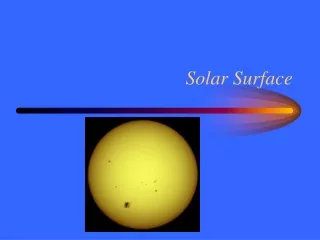
Sun Facts • The Sun is a gas cloud of mostly hydrogen and helium. • The age is about 5 billion years. • Diameter: about 100 times Earth’s • Volume: about 1,000,000 times Earth’s • Mass : about 300,000 times Earth’s • Density = mass/volume = 1.4 g/cm3 • water is 1.0 g/cm3, Earth is 5.6 g/cm3
Luminous Gas • We only see the surface of the sun. • Not a solid surface • Temperature 5,800 K = 10,000 °F • Hot enough for visible light • Gases extend upward for thousands of km.
Solar Atmosphere • The Sun’s atmosphere is divided into three layers. • Different temperatures and densities chromosphere corona photosphere Sun’s interior
Eye on the Sun • The Solar Dynamics Observatory is in orbit around the Earth. • Launched Feb 2010
Photosphere • The visible surface is the photosphere. • Brightest part of the sun • The photosphere has features that show convection. Granules: Dark areas are cool and are sinking. Light areas are hot and are rising. Supergranules: Doppler color shows rising and sinking.
The chromosphere is immediately above the photosphere. Temperature to 20,000 K Faint compared to photoshpere Red from hydrogen gas The chromosphere is the site of prominences of hydrogen gas. Chromosphere
Corona • The outermost layer of the sun is the corona. • It can be easily seen during total eclipses. • It is as bright as the full moon. • The gas is thin but heated to over 1,000,000 K.
Solar Wind • This solar wind streams away from the sun at high speed (300 to 800 km/s). • The solar wind distorts planetary magnetic fields. • Measured beyond Neptune