Download
1 / 19
190 likes | 332 Vues
This research explores the complexities of solar activity, particularly sunspots and their deep-rootedness in the solar dynamo. It examines various scenarios of the solar dynamo, including distributed, overshoot, and interface dynamos, and highlights the importance of near-surface shear in understanding sunspot formation and behavior. The study utilizes simulations and theories to analyze magnetic buoyancy, pressure instabilities, and the role of meridional circulation. The findings are pivotal in shedding light on solar cycles and predicting future solar activities.

E N D
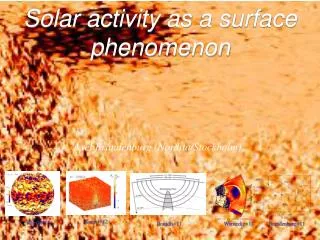
Is solar activity a surface phenomenon? Axel Brandenburg (Nordita/Stockholm) Kemel+12 Käpylä+12 Ilonidis+11 Warnecke+11 Brandenburg+11
How deep are sunspots rooted? • may not be so deeply rooted • dynamo may be distributed • near-surface shear important Hindman et al. (2009, ApJ) Kosovichev et al. (2000)
Sunspot proper motion: rooted at r/R=0.95? Benevolenskaya, Hoeksema, Kosovichev, Scherrer (1999) Pulkkinen & Tuominen (1998)
The 4 solar dynamo scenarios • Distributed dynamo (Roberts & Stix 1972) • Positive alpha, negative shear • Overshoot dynamo (e.g. DeLuca & Gilman 1986) • Negative alpha, positive shear • Interface dynamo (Parker 1993) • Negative alpha in CZ, positive radial shear beneath • Low magnetic diffusivity beneath CZ • Flux transport dynamo (Dikpati & Charbonneau 1999) • Positive alpha, positive shear • Migration from meridional circulation
Steps toward the overshoot dynamo scenario • Since 1980: dynamo at bottom of CZ • Flux tubes buoyancy neutralized • Slow motions, long time scales • Since 1984: diff rot spoke-like • dW/dr strongest at bottom of CZ • Since 1991: field must be 100 kG • To get the tilt angle right Spiegel & Weiss (1980) Golub, Rosner, Vaiana, & Weiss (1981)
Is magnetic buoyancy a problem? Stratified dynamo simulation in 1990 Expected strong buoyancy losses, but no: downward pumping Tobias et al. (2001)
Flux storage Distortions weak Problems solved with meridional circulation Size of active regions Neg surface shear: equatorward migr. Max radial shear in low latitudes Youngest sunspots: 473 nHz Correct phase relation Strong pumping (Thomas et al.) Arguments against and in favor? Tachocline dynamos Distributed/near-surface dynamo in favor against • 100 kG hard to explain • Tube integrity • Single circulation cell • Turbulent Prandtl number • Max shear at poles* • Phase relation* • 1.3 yr instead of 11 yr at bot • Rapid buoyant loss* • Strong distortions* (Hale’s polarity) • Long term stability of active regions* • No anisotropy of supergranulation Brandenburg (2005, ApJ 625, 539)
Simulations of the solar dynamo? • Tremendous stratification • Not only density, also scale height change • Near-surface shear layer (NSSL) not resolved • Contours of W cylindrical, not spoke-like • (i) Rm dependence (catastrophic quenching) • Field is bi-helical: to confirm for solar wind • (ii) Location: bottom of CZ or distributed • Shaped by NSSL (Brandenburg 2005, ApJ 625, 539) • Formation of active regions near surface
Ghizaru, Charbonneau, Racine, … • Cycle now common! • Activity from bottom of CZ • but at high latitudes
Dynamo wave from simulations Kapyla et al (2012)
Alternative sunspot origins Kitchatinov & Mazur (2000) Rogachevskii & Kleeorin (2007) Brandenburg, Kleeorin , & Rogachevskii (2010) Stein & Nordlund (2012)
Negative effective magnetic pressure instability • Gas+turb. press equil. • B increases • turb. press. decreases • net effect?
How can pressure be negative?? • Just virtual? • Magnetic buoyancy? Kemel et al. (2012) Brandenburg et al. (2011)
Predictive power of mean-field approach DNS Mean-field simulation (MFS)
True instability: exponential growth • Several thousand turnover times • Or ½ a turbulent diffusive time • Exponential growth linear instability of an already turbulent state
NEMPI coupled to dynamo • Explains disappearence • Other problems • Sensitivity to rotation • Nonaxisymmetry? MFS Losada et al. (2013) Jabbari et al. (2013)
Broader mean-field concept a effect, turbulent diffusivity, Yoshizawa effect, etc Turbulent viscosity and other
Conclusions • Interest in predicting solar activity • Cyclonic convection ( helicity) • Near surface shear migratory dynamo • Bi-helical fields, inverse cascade • Solar wind also bi-helical field, but reversed • Formation of active regions and sunspots by negative effective magnetic pressure inst.