Bulk Scintillator Light Yield
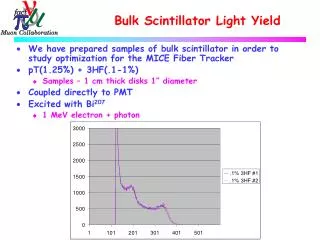
This study focuses on the optimization of bulk scintillator samples to enhance light yield for MICE Fiber Tracker applications. We prepared 1 cm thick, 1" diameter disks coupled directly to PMTs and excited with Bi207. Light yield uniformity is approximately 5% RMS. Our findings indicate no significant change in light yield for 3HF concentrations above 0.1%. Further investigations include scanning both pT (1-2%) and 3HF (0.25-1%) concentrations to understand the energy transfer in fibers, which is critical for minimizing light loss due to absorption phenomena.

Bulk Scintillator Light Yield
E N D
Presentation Transcript
Bulk Scintillator Light Yield • We have prepared samples of bulk scintillator in order to study optimization for the MICE Fiber Tracker • pT(1.25%) + 3HF(.1-1%) • Samples – 1 cm thick disks 1” diameter • Coupled directly to PMT • Excited with Bi207 • 1 MeV electron + photon
Bulk Scintillator Light Yield • Uniformity of sample preparation is approximately 5% rms • Surface polish • polymerization • From table, no real change in light yield for 3HF concentration > 0.1% • Next • Scan in both pT concentration (1-2%) and 3HF concentration (.25-1%)
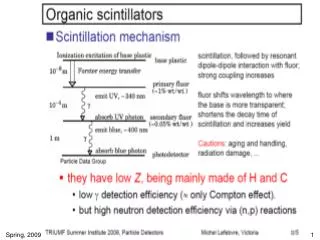
Fiber Properties • Energy deposited in the fiber is first transferred to the primary dopant, pT (para-terphenyl) • Peak emission – 350 nm • The secondary (3HF) then absorbs this light and reemits at longer wavelength • 350 nm ®525 nm • Light can be lost in the fiber if this absorption length (350 nm ®525 nm) is large compared to the fiber diameter • A = 10-ecL • A = Absorption • e = molar absorbtivity (for 3HF = 1.4 X 10⁴M-1cm-1 @ 350 nm) • L = length • From these numbers we can determine the 1/e absorption length for a concentration of 0.25% by weight (10-2 M/liter, MW=240 with 2.5g/l) • log(1/e)=-ecL = -1.4X10⁴M-1cm-1 X 10⁻²M X L • L= 25 mm • Therefore, a concentration > 0.25% (by wt.) 3HF should not be needed