Download
1 / 21
210 likes | 316 Vues
This study explores the impact of the Kepler space mission on our understanding of extra-terrestrial life frequency. It addresses key questions such as the prevalence of terrestrial exoplanets, their Earth-like characteristics, and their positions in habitable zones. The research highlights how Kepler has revolutionized exoplanet discoveries and assesses the likelihood of biotic worlds throughout the galaxy. Through various methods like the Doppler and transit techniques, the paper offers insights into the types of stars suitable for life and the probabilities of finding habitable planets.

E N D
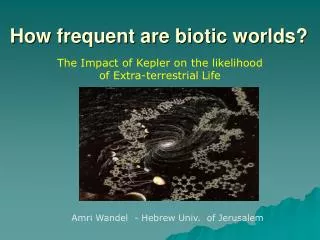
The Impact of Kepler on the likelihood of Extra-terrestrialLife How frequent are biotic worlds? Amri Wandel - Hebrew Univ. of Jerusalem
How frequent are terrestrialexo-planets? • Do other stars have planets? • If so, are they Earthlike? • Are they in the Habitable zone? • The exo-planet boom • What has changed with Kepler? ILASOL 2012 A. Wandel
Star types suitable for the evolution of life • Too big(M>1.5Mo)- Main Sequence lifetime insufficient for the evolution of life • Too small (<0.5 Mo) - eruptive (planetary temperature instable) • This leaves ~ 10% of all stars. ILASOL 2012 A. Wandel
Planetary disks being born in Orion עוברי כוכבים ו”מערכות שמש” בערפילית אוריון
The Doppler method V*~mp ap-1/251 Peg ILASOL 2012 A. Wandel
Doppler method is biased towards massive,nearplanets ILASOL 2012 A. Wandel
CoRoT Darwin SIM Kepler Observatories in Space ILASOL 2012 A. Wandel
The transit method The inclination must be very close to 90° ILASOL 2012 A. Wandel
HD209458 • Planet mass • Planet radius • Planet density ILASOL 2012 A. Wandel
Sensitivity of exo-planet projects • Radial velocity (Doppler) • Transit • Micro-lensing ILASOL 2012 A. Wandel
The Kepler mission Search Earthlike exo-planets ILASOL 2012 A. Wandel
How many biotic woldssexist in the Galaxy ? ? Kepler 20e,f 19.12.2011 ? Kepler 22b 5.12.2011 1011 stars 10% Sunlike Planets in HZ Earthlike nHZ ILASOL 2012 A. Wandel
How frequent is extra-terrestrial life? ILASOL 2012 A. Wandel
Probability for a terrestrial planet to become biotic vs. cosmic time probability Earth ILASOL 2009 Amri Wandel Time (bill.yrs)
Probabilities for terrestrial planetsand biotic worlds Average distance to nearest biotic exoplanet: Db~10 ly (FpFb) -1/3 Let’s assume two extreme scenarios: Optimistic: Fp=1, Fb=1, Db~10 ly Pessimistic: Fp=0.01, Fb=0.001 Db~500 ly
Distance to nearest biotic planet 11+Log (FpFb) ILASOL 2012 A. Wandel
Probability for a biotic planet within 100 ly 11+Log (FpFb) ILASOL 2012 A. Wandel
After Kepler extra-terrestrial life Seems to be much more likely