Essential Writing Tips for Clear and Effective Communication
Master the art of writing with these essential tips! Avoid run-on sentences and double negatives to ensure clarity. Make sure verbs agree with their subjects and eliminate sentence fragments. Proofread your work to catch any missing words. Steer clear of redundancies and unnecessary commas, and avoid starting sentences with conjunctions. Keep exclamation marks, hyphenation, and clichés in check. Strengthen your body paragraphs with a clear topic sentence and supporting details using the DRAPES method. Lastly, ensure your introduction and conclusion effectively capture your ideas.

Essential Writing Tips for Clear and Effective Communication
E N D
Presentation Transcript
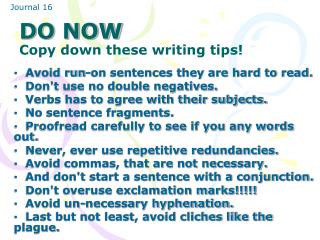
Journal 16 DO NOWCopy down these writing tips! · Avoid run-on sentences they are hard to read. · Don't use no double negatives. · Verbs has to agree with their subjects. · No sentence fragments. · Proofread carefully to see if you any words out. · Never, ever use repetitive redundancies. · Avoid commas, that are not necessary. · And don't start a sentence with a conjunction. · Don't overuse exclamation marks!!!!! · Avoid un-necessary hyphenation. · Last but not least, avoid cliches like the plague.
Body Paragraphs Class Notes 23 • The body paragraphs are the core of your paper. • They provide the evidence and support for your opinion.
Body Paragraphs • Strong body paragraphs are logically organized and contain clearly linked details. • Each of your 3 body paragraphs will include: • a topic sentence (idea!) • 3 supporting details
DRAPES • What can I use as supporting details? Use DRAPES! • DRAPES builds details and elaboration in your writing
D – Dialogue/Quote from someone in authority R – Rhetorical question A – Analogy P – Personal Experience E – Example S – Statistic
Peer Edits Introduction Checklist: • Does the opening sentence draw you in? • Are there general details about the subject? • Is the thesis located at the end of the introduction? • Does the thesis include an opinion and 3 supporting ideas? • Is the thesis strong? Conclusion Checklist: • Is there a counterargument? • Is there a rebuttal? • Does the author provide a summary of the ideas? • Is there a final thought?