Download
1 / 16
160 likes | 278 Vues
This study examines the structural differences between the rotamers of phenylalanine and tyrosine using advanced 3D modeling software. Utilizing HINT (Hydropathic Interactions) analysis, we explore interactions derived from over 30,000 tyrosine samples. The experimental data, presented through various statistics and graphical representations, reveal significant clustering phenomena and interaction environments. This detailed comparison enhances our understanding of these pivotal amino acids in protein design and structure-function relationships, offering insights for future research in molecular biology.

E N D
Comparison of Phenylalanine v. Tyrosine rotamers using 3D modeling software Sam Portillo BNFO 300
PDB Statistics1 Table 11
Ahmed et al (2015) uses “hint!” (hydropathic intactions) Fig. 14,5
Ahmed et al (2015) used hint! to analyze 30,000 tyrosines Fig. 21,4
Clusters found in square a11 Fig. 34
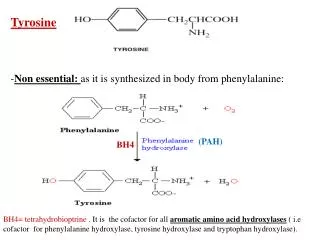
Tyrosine Phenylalanine The Experiment Fig. 47
Tables 2,34 Residue phi psi a b c d e f g h N-term Tyr 1 631 2240 713 46 0 3 5 0 0 2 2 22 13 1 0 13 0 0 1 3 1 24 36 31 2 7 6 0 1 4 6 228 2888 5376 3 21 7 1 6 5 5 700 2449 250 2 85 157 1 2 6 13 345 232 0 1 414 26 0 0 7 20 710 585 21 2 36 8 0 6 8 332 5301 4005 854 1 4 4 0 17 C-term 12 95 55 0 0 3 0 1 Residue phi psi a b c d e f g h N-term Phe 1 735 2150 724 44 0 1 0 1 4 2 3 16 19 1 0 8 2 0 1 3 4 42 33 27 11 4 0 1 7 4 6 190 3438 6364 4 5 14 0 16 5 4 679 2410 276 0 81 64 0 9 6 8 375 362 2 0 349 19 0 14 7 31 745 777 18 0 12 1 1 26 8 385 5118 4603 787 1 2 9 2 27 C-term 23 98 76 2 1 6 0 0
Ulmschneider Study Fig. 58
References • Berman, H. M., Westbrook, J., Feng, Z., Gilliland, G., Bhat, T. N., Weissig, H., … Bourne, P. E. (2000). The Protein Data Bank. Nucleic Acids Research, 28, 235–242. Retrieved from https://www.rcsb.org/pdb/statistics/holdings.do • Salzberg, S. L., Searls, D. B., & Kasif, S. (1998). Grand Challenges in Computational Biology. In Computational Methods in Molecular Biology (pp. 3–10). Elsevier Science B.V. Retrieved from https://app.knovel.com/web/view/khtml/show.v/rcid:kpCMMB0001/cid:kt00BYFA5K/viewerType:khtml/root_slug:1-grand-challenges-in-computational-biology/url_slug:grand-challenges-in-computational?b-toc-cid=kpCMMB0001&b-toc-root-slug=&b-toc-url-slug=grand-challe • Huang P-S, Boyken SE, Baker D. The coming of age of de novo protein design. Nature. 2016;537(7620):320-327. doi:10.1038/nature19946. • Ahmed, M. H., Koparde, V. N., Safo, M. K., Neel Scarsdale, J., & Kellogg, G. E. (2015). 3D interaction homology: The structurally known rotamers of tyrosine derive from a surprisingly limited set of information-rich hydropathic interaction environments described by maps. Proteins: Structure, Function and Bioinformatics, 83(6), 1118–1136. https://doi.org/10.1002/prot.24813 • Ramachandran GN, Ramakrishnan C, Sasisekharan V. Stereochemistry of polypeptide chain configurations. J Mol Biol. 1963;7(1):95-99. doi:10.1016/S0022-2836(63)80023-6. • Peptide Bonds and Protein Backbones. • Helmenstine, A. M. (2017). Amino Acid Structures. Retrieved from https://www.thoughtco.com/amino-acid-structures-4054180 • Ulmschneider, M. B., & Sansom, M. S. P. (2001). Amino acid distributions in integral membrane protein structures. BiochimBiophys Acta, 1512(1), 1–14. https://doi.org/10.1016/S0005-2736(01)00299-1


![Data Modeling [Comparison of data modeling techniques ]](https://cdn0.slideserve.com/205866/data-modeling-comparison-of-data-modeling-techniques-dt.jpg)

![Data Modeling [Comparison of data modeling techniques ]](https://cdn3.slideserve.com/6795343/data-modeling-comparison-of-data-modeling-techniques-dt.jpg)