Download
1 / 20
210 likes | 343 Vues
This work delves into the complex processes of speciation and evolutionary adaptation among various plant species, including Larkspurs, Columbines, and Beach Peas. Highlighting the roles of genetic and ecological isolation, differential selection, and pollinator shifts, the study examines how these factors influence traits like flower morphology and pollination dynamics. By analyzing dramatic differences in species like Delphinium and Polemonium, the researchers reveal key mechanisms driving adaptation and diversification in North American flora.

E N D
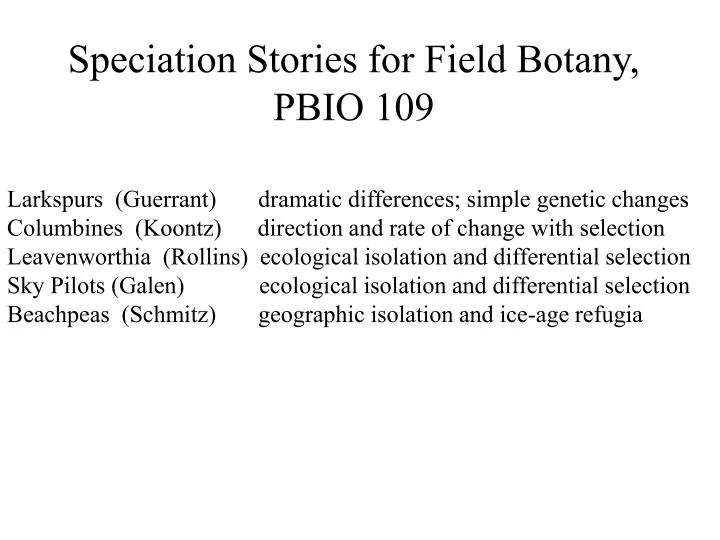
Speciation Stories for Field Botany, PBIO 109 Larkspurs (Guerrant) dramatic differences; simple genetic changes Columbines (Koontz) direction and rate of change with selection Leavenworthia (Rollins) ecological isolation and differential selection Sky Pilots (Galen) ecological isolation and differential selection Beachpeas (Schmitz) geographic isolation and ice-age refugia
Delphinium nudicaule Delphinium decorum
D. cardinale also from western North America Only remotely related - see Koontz et al. 2004
Distribution of Delphinium decorum, D. nudicaule, and their hybrid D. luteum. from Koontz et al., 2001
Pollinator shifts drive increasingly long nectar spurs in columbine flowers. Whittall and Hodges, 2007 ---- Nature 447: 706-710.
Leavenworthia crassa Leavenworthia exigua
SKY PILOT VARIANTS And ELEVATION OdorCorolla Flair narrow wide skunky COMMON RARE (sepals) UP HIGH Odor sweet RARE COMMON (petals) DOWN LOW
References Galen et al. 1987. Pollination in floral scent morphs of Polemonium viscosum. Evolution. Guerrant, 1982. Neotrenic evolution in larkspurs. Evolution. Schmitz, 2002. The evolutionary and biogeographic history of Lathyrus japonicus (beach pea) in North America, PhD thesis UVM. Solbrig and Rollins. 1977. The evolution of autogamy in species of Leavenworthia. Evolution. Whittall and Hodges . 2007. Pollinator shifts drive increasingly longer spurs in columbines. Nature.